

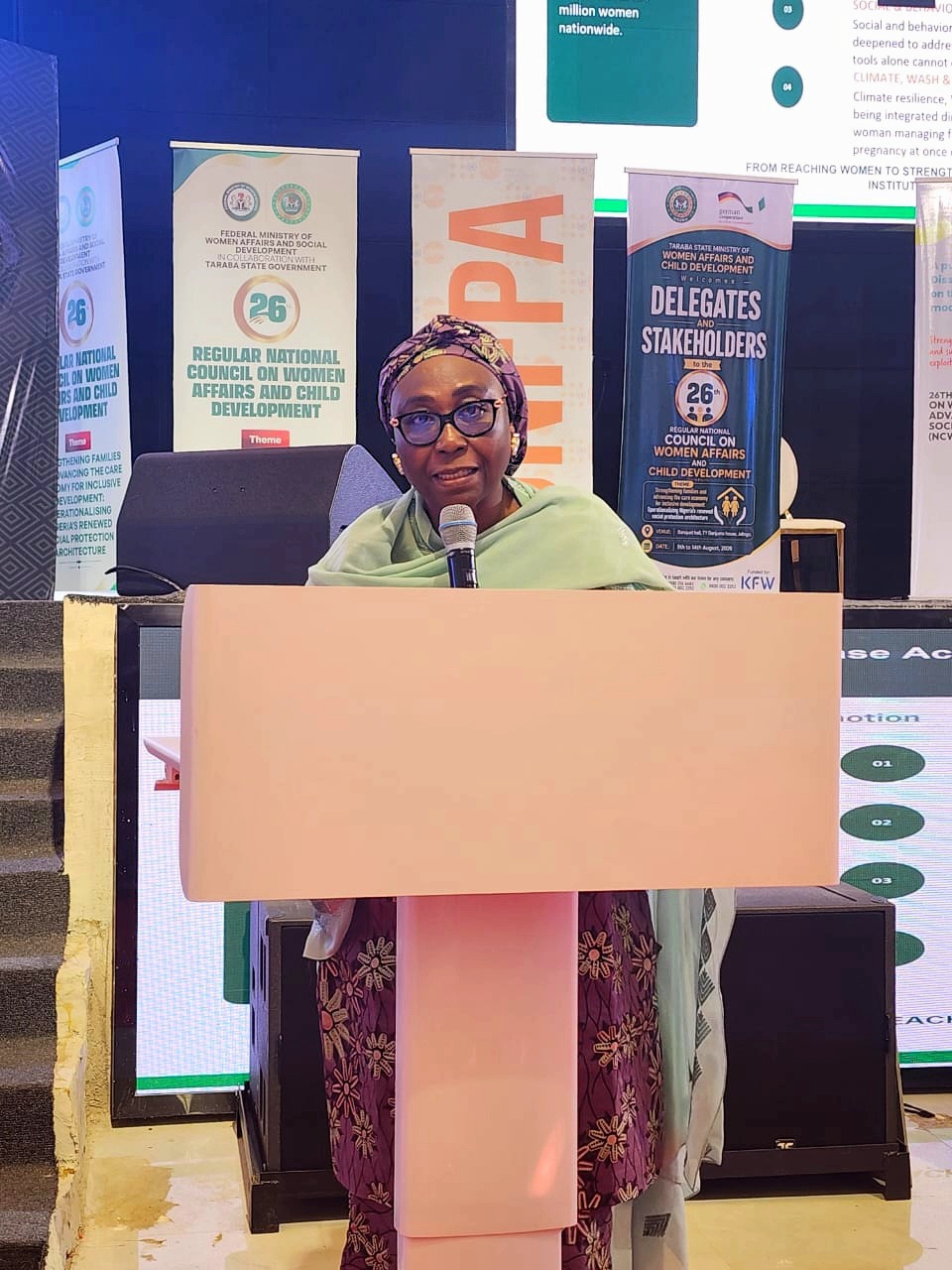
Dr Hadiza Maina, National project Coordinator of Nigeria for women program says the Nigeria for Women Program Scale-Up (NFWP-SU), has mobilized ₦10.982 billion thru members’ savings to strengthen women-led community institutions.
The development is a pathway to increased economic opportunities, financial inclusion and resilience for women.
Maina made the comments at the 26th National Council on Women Affairs, Child Advancement and Social Development, in Jalingo, Taraba State, in a paper titled “Nigeria for Women Scale-up: The Transforming Potential of Women Collectives.”
The program is being coordinated under the leadership of the Minister of Women Affairs and Social Development, Imaan Sulaiman-Ibrahim.
The presentation described NFWP as a strategic long-term partnership between the Nigerian Government and the World Bank, aimed at institutionalizing Women Affinity Groups (WAGs) and other platforms for women economic empowerment.
She said “the over 60 per cent multidimensional poverty of Nigerian women is associated with limited access to factors of production.
NFWP is institutionalizing this existing practice, “turning informal savings into a scalable engine for national economic growth,” says Dr Maina.
The pilot phase from 2018 to 2024 in Abia, Akwa Ibom, Kebbi, Niger, Ogun and Taraba States, she said, created WAGs thru voluntary individual self-selection, offering structured platforms for women to get access to finance and improve mutual support.
Under the Scale-Up phase, the program aims at reaching over 10 million Nigerian women by 2028, across all the 36 states and the Federal Capital Territory.
Dr. Maina said so far, 66,928 Women Affinity Groups (WAGs) had been formed with 1,482,459 women actively involved as direct beneficiaries. “In Ekiti State, about ₦62.4 million in Community Investment Fund grants has been disbursed to 142 WAGs.
NFWP-SU has also facilitated the opening of bank accounts and National Identification Number (NIN) enrollment for over 60 percent women beneficiaries.
She identified WAGs as platforms to strengthen women’s voice, agency and resilience and to improve access to finance, markets and productive opportunities.
NFWP-SU has three components: • Support to community institutions • Support to livelihoods collectives and project management • Support to monitoring, evaluation and learning
The Community Investment Fund provides seed capital for micro-investment plans and Livelihoods Collectives aggregate WAG members for value-chain development, market access and business growth.
But in her presentation she noted implementation challenges including differences in pace of implementation, differences in States readiness, concerns regarding data quality and timeliness, diverse community contexts and security risks.
“Adaptive implementation is important,” Maina said, adding that structural and cultural differences between states and communities meant delivery approaches, timelines and messaging had to be tailored to local realities.
She said the “programme is prioritizing digital financial services and fintech partnerships, development of a self-sustaining Community Investment Fund, deeper social and behavior change programming and integration of climate resilience, WASH and reproductive health into the economic model.”
Dr Maina urged for a strategic shift “from reaching women to strengthening women-led institutions,” saying that “collective action is the pathway to sustainable economic empowerment and resilience for millions of Nigerian women.”
