

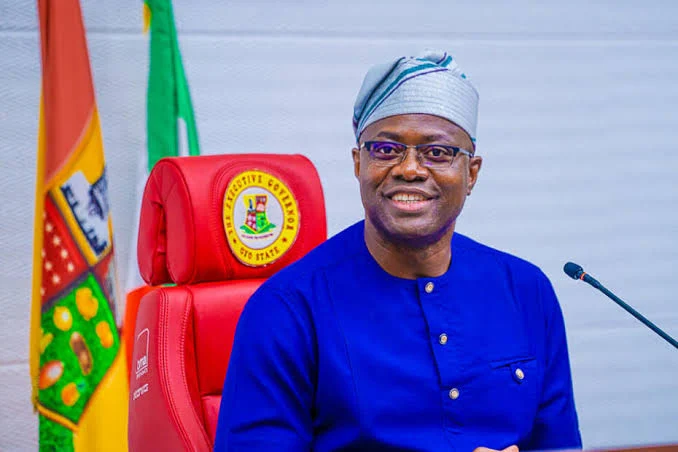
Oyo State Governor and presidential candidate of the Allied Peoples’ Movement, Seyi Makinde, has said Nigeria needs a complete reset, not mere reform, to move forward.
Makinde made the declaration on Sunday while speaking in Jos, Plateau State, on a live political programme of Jay FM radio station in Jos ahead of the flag-off of his party’s 2027 presidential campaign scheduled to hold in the city on Monday.
On his proposed reset agenda, Makinde identified the economy as the foremost priority, insisting that economic performance should be measured by the living conditions of ordinary Nigerians.
He said, “We can do reform when the good within the system is more than the bad, then you say we can tweak it and things like that. But if in a situation where the good within your system is just like 20% of your expectations, at that point,
“it’s just like your own computer system, if it keeps hanging and you want to run a programme on it, the best cause of action for you is not about tweaking the programme. You have a button, a reset button. Basically, you will shut down everything, reboot it and then you have a clearer path to proceed with your programme going forward.
“So, reform is not going to work within the environment we are in. I was not born a politician, I decided that I must participate because the future of millions of our people are involved and also for potentially the greatest black country on the face of the earth, their destiny are also involved.
“The economy must work for everybody. It is not about taking numbers out and saying external reserves have grown or quoting what the World Bank said about inflationary trends.
“What is the ordinary man on the street feeling? Are they able to feed themselves?”
He called for greater investment in skills acquisition, entrepreneurship, education and intensive production, arguing that Nigeria must create an enabling environment for businesses to thrive and provide employment opportunities for its youthful population.
Makinde also promised to decentralise Nigeria’s security architecture through the establishment of state police if elected president in 2027.
He said state police would enable governors to respond more effectively to security challenges in their respective states, adding that states willing and ready to establish the institution should be allowed to do so with appropriate safeguards.
The governor, who reiterated his long-standing support for state police, recalled that he had advocated the establishment of state police shortly after assuming office in 2019 following growing security concerns across the country.
“When I became governor, we already had security challenges in different parts of the country. We approached the late President Muhammadu Buhari towards the end of 2019 and said, look, I think we should have state police.”
“At that time, the argument was that some states were not even able to pay workers’ salaries. Now you want them to establish state police. They asked how they could do that when they were unable to pay their workers,” he said.
Makinde explained that governors in the South-West subsequently established the Western Nigeria Security Network, popularly known as Amotekun, as an alternative security arrangement pending the establishment of state police.
“Amotekun was a midway between having full-fledged state police and having nothing.”
“If these operatives would only be permitted to carry sticks, they could gather intelligence. They would be there, they could see what was happening and provide useful information.”
“That was the compromise at the time, and I am happy to report that we have not had issues getting them to work with the federal security agencies. It has worked very well in our region,” he stated.
The governor acknowledged concerns that state police could become a tool in the hands of some governors to oppress citizens and political opponents, but maintained that appropriate safeguards could address such fears.
“Those concerns are legitimate because some people believe it could become a tool in the hands of state governors to oppress the people.”
“But we have gone through this type of arrangement before. We do not all have to establish state police at the same time.”
“Let the opportunity exist. If you think you are ready, you have ticked the boxes and put the safeguards in place, you should go ahead and secure your state,” he said.
Makinde further argued that Nigeria needed a security arrangement that reflected the realities of individual states, rather than relying entirely on a centralised structure.
He also linked insecurity to the absence of economic opportunities for young Nigerians, warning that failure to provide a clear future for the country’s growing youth population could worsen security challenges.
“Some of these young people are now getting involved in crime and criminality because we have not given them a path to the future.”
“If you do not give opportunities to the coming generation, it is a recipe for bigger conflicts ahead of us,” he said.
The APM presidential candidate noted that Nigeria’s population was projected to exceed 300 million, with more than 70 per cent expected to be below 34 years, stressing the need for deliberate policies to harness the potential of young people.
He recalled the experience of the South-West region in the pre-independence era, saying, “We will have self-governance. And then people were allowed to go on their own trajectory until 1957, when everybody said, ‘Now we’ve learned enough, we’ve put the safeguards in place, and we can now get into self-governance.’”
“So, by 1957, everybody had aligned. By 1960, Nigeria already had its independence. So, we don’t all have to set up state police at the same time. But let the opportunity exist. If you think you’re ready, you’ve ticked all the boxes and things like that, you should go ahead and secure your seat.”
Makinde also recalled his stance during the COVID-19 pandemic in 2020, when he declined to impose a total lockdown in Oyo State.
He said, “I’m faced with an almost identical situation in 2020. Six months after we got into government, COVID hit. And we had a meeting, a National Economic Council meeting in Abuja. And the Vice President, who normally would chair the National Economic Council, came in and said, ‘Well, mandatorily, we can see what is happening around the world. All of you should go and lock down your states.’”
“And I said, ‘Sir, me, I cannot lock down my state because I know people in your state who, if they don’t go out today, have no food to eat that night or even the following day. How are we going to look after these people?’”
“So, we had an argument back and forth. Eventually, we agreed that it should be optional. If you think your state needs to be locked down, lock your state down.”
“And I didn’t lock down my state. People criticised me at that time and said, ‘Well, she is going to kill the people in her state,’ and things like that. But we were dealing with science, data and logic. It wasn’t as if I had 100 per cent alignment within my own team as well.”
He added, “But something stood out clearly: the 1918 Spanish flu, which was almost similar to COVID. After that flu, people in temperate regions started having flu shots every year. We were not having flu shots here. Very well.”
“We were going through from 1918 till 2020. So, this idea even came from the virology unit at the University of Ibadan.”
“They said, ‘Well, we’re studying this. We need to manage things and all of that.’”
“And I said, ‘Well, some of our people would rather die of COVID than die of hunger because they know they can deal with hunger if they go out.’”
“So, we’ve done it before. We can do the same with state police, and it will help the security situation at the state level.”
On education, Makinde said he remained a firm believer in the vision of the late Chief Obafemi Awolowo on free education.
He said, ” In fact, if I look at what Awolowo did many, many years ago, I wish it would be replicated because this is a visionary, someone who saw tomorrow and told the ordinary cocoa farmers that, ‘Look, if you give me your tax, your children will go to school free, and if they go to school free, they will become something great in the future, and they will come and support you.’”
“And that was what exactly happened.
On how he intends to reinvigorate higher education to make institutions research hubs, Makinde said, “Well, you know, I kept saying that the first thing we will do is to let Nigerians know sincerely our situation. Don’t hide anything. Bring it forward.”
“And the next thing we will do is to ensure that we have accountability.
