

Rising drug prices and worsening economic hardship are making diabetes treatment increasingly unaffordable for many Nigerians, forcing patients to abandon prescribed medications, reduce their dosages, and turn to herbal remedies. Experts warn that the trend is exposing patients to potentially life-threatening complications, IDOWU ABDULLAHI reports
Living with diabetes has become a daily battle between survival and hunger for Atanda Rasaki.
Every morning in his one-room apartment in the Ipaja area of Lagos, the 68-year-old retired truck driver carefully checks the small nylon bag where he keeps his medications.
Sometimes, he stares at his nearly empty vial of insulin and tablet sachets with fear creeping into his mind.
“There are days I deliberately reduce the dosage because I cannot afford to buy another one immediately,” he told PUNCH Healthwise.
Rasaki, who was diagnosed with Type 2 diabetes in 2010, said the cost of managing the condition had increased sharply in recent years, especially after the removal of fuel subsidies.
“The insulin we used to buy for N3,500 to N5,000 before now costs over N18,000. The lowest drug in terms of cost is N5,000 per pack; there are those of over N10,000.
“Before, I could still manage to buy my drugs every month. But now, insulin, test strips, drugs, and even the food doctors asked us to eat have become too expensive. Sometimes, I just drink water and sleep,” he lamented.
The father of four recalled how he was rushed to a hospital early this year after collapsing from complications linked to uncontrolled blood sugar.
“In February, I collapsed and nearly died because I stayed off my medications for some days. I could not afford it,” he added.
Unbearable burden
“Managing diabetes in this country is becoming an unbearable burden. I just wish the government could help people like us,” a 60-year-old widow, Mrs Funke Ayoola, told PUNCH Healthwise.
Diagnosed with Type 2 diabetes in 2006, Ayoola said she now mentally calculates how long her medications can last before seeking money to buy another pack she can barely afford.
“N40,000 for diabetes drugs alone in one month, and I still buy arthritis drugs for about N20,000,” she lamented while showing our correspondent the packets of drugs.
Ayoola, who has lived with diabetes for two decades, said worsening economic hardship and rising medication prices have steadily pushed treatment beyond her reach.
“Once I finish these, I honestly don’t know where the money for the next one will come from,” the widow, whose only source of income is monetary support from her two sons, said.
According to her, the human insulin vial she depends on now sells for about N20,000, nearly double its previous price.
“Before now, it was around N10,000. Now, I just reduce the dose of insulin I use daily,” the mother of two, who lives in the Ilasamaja area of Lagos, lamented.

“We are supposed to adhere to our treatment regimen every day. But because of the cost, I now use my drugs once daily instead of twice. I also use herbal medicine to supplement them,” she added.
According to her, there was a period when I stopped taking the prescribed drugs completely because I could no longer afford them.
“At that time, I depended only on herbs. But my condition was not improving, so I had to start mixing herbs with orthodox medicine,” she recalled.
After spending N40,000 on medications expected to last one month, Ayoola said she stretches them beyond a month.
“I will use herbs in the morning and take tablets at night so the drugs can last longer. That is what I do for it to last two months,” she said.
Rasaki and Ayoola’s realities are not isolated. Across Nigeria, many diabetes patients are increasingly struggling under the crushing cost of treatment, leading to severe diabetes-related complications and, in some cases, preventable deaths.
Diabetes at glance
Diabetes mellitus is a chronic disease that occurs when the body cannot properly regulate blood sugar levels.
The World Health Organisation says the condition develops either because the body does not produce enough insulin or cannot effectively use the insulin it produces.
Insulin is a hormone, produced by the pancreas, that helps sugar move from the bloodstream into body cells where it is used for energy.
When blood sugar remains consistently high, it can damage major organs, including the eyes, kidneys, nerves, heart, and blood vessels.
There are three main types of diabetes: type 1, which affects mostly children and adolescents; type 2, which accounts for about 85 per cent of global cases and affects mainly adults; and gestational diabetes, which occurs in pregnant women.
The International Diabetes Federation says approximately 589 million adults are living with diabetes worldwide. It added that 11.1% or 1 in 9 of the adult population is living with diabetes, with over 4 in 10 unaware that they have the condition.
By 2050, IDF projects that approximately 853 million people will be living with diabetes.
In Nigeria, the diabetes burden is also significant and rising.
About 11.5 million Nigerians are currently living with diabetes, according to the Diabetes Association of Nigeria.
DAN says the actual number could be more than double, as more than two-thirds of people living with diabetes in Nigeria have not even been diagnosed.
Medical experts have linked rising diabetes cases in Nigeria to unhealthy diets, obesity, physical inactivity, stress, urbanisation, and genetic factors.
Early action
World Diabetes Day is celebrated on November 14 annually. The 2026 commemoration is themed, “Early action on diabetes.”
The theme campaign emphasizes early diagnosis, timely intervention, and reducing diabetes risk factors.
Experts say without early diagnosis, people living with diabetes may not be able to access the care, treatment, and support they need to manage the condition and live healthy lives.
In Nigeria, endocrinologists have consistently said delayed diagnosis exposes patients to life-threatening complications.
They also called for more public awareness to encourage early detection of diabetes, noting that early screening remains the most effective way to curb the rising cases.

Costly medication
While many Nigerians remain undiagnosed until severe complications emerge, findings by PUNCH Healthwise show that many patients who have been diagnosed with diabetes are struggling with the high cost of medication to manage the condition.
The removal of fuel subsidies significantly increased medication costs, worsening the burden on patients already struggling with the high cost of living.
Also, PUNCH Healthwise reports that the disruptions in international pharmaceutical supply chains in February 2026 following US-Iran conflicts have also contributed to higher drug prices in Nigeria.
Meanwhile, Nigeria imports over 70 per cent of its medicines and medical consumables, making the healthcare sector highly vulnerable to global supply disruption or economic shocks.
Findings showed that the cost of diabetes medications and other essentials has risen by over 200 per cent in the last three years.
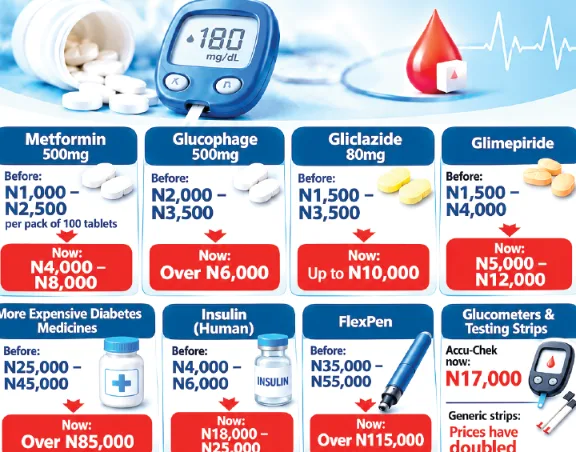
For instance, a market survey by PUNCH Healthwise from May to November 2026, showed that Metformin 500mg, commonly used in diabetes management, which previously sold for between N1,000 and N2,500 per pack of 100 tablets, now costs between N4,000 and N8,000 depending on location.
Similarly, Glucophage 500mg has risen from about N2,000–N3,500 to over N6,000 in some pharmacies.
Other oral diabetes medications, like Gliclazide 80mg, which previously cost between N1,500 and N3,500, now sell for as high as N10,000, while Glimepiride climbed from about N1,500–N4,000 to between N5,000 and N12,000 depending on dosage and brand.
More expensive diabetes medicines rose from about N25,000–N45,000 before subsidy removal to over N85,000 currently.
Also, insulin and diabetes monitoring devices have become more expensive, worsening the financial burden on patients requiring lifelong treatment.
Human insulin vials and cartridges, previously sold for between N4,000 and N6,000, now cost as much as N18,000 to N25,000, while FlexPen packs have risen from around N35,000–N55,000 to over N115,000.
In the same vein, the prices of glucometers and testing strips like Accu-Chek now sell for as high as N17,000, and generic glucose strips have doubled their previous prices.
With the rise in prices of diabetes medications, PUNCH Healthwise findings show that a patient may spend between N100,000 and N150,000 monthly to manage the condition, depending on the medicines involved.
“Some patients require at least two vials every month. That is only for insulin injections. When you add oral medications, glucometers, blood sugar testing strips, and other supplies, the cost becomes overwhelming,” the National President, Diabetes Association of Nigeria, Prof Ejiofor Ugwu, told PUNCH Healthwise.

Also, a pharmacist, Abiodun Obube, said many diabetes patients can no longer afford their cost of care.
“For diabetic patients, the biggest burden is no longer only the medicine itself but the monthly cost of full care: drugs, insulin, test strips, lancets, consultation, diet, and transport.
“A patient using insulin and testing daily may now spend N50,000–N150,000 monthly, depending on insulin type, testing frequency, and complications,” Obube, who is the immediate past vice chairman of the Pharmaceutical Society of Nigeria, Ogun State chapter, told PUNCH Healthwise.

This means that at N150,000 a month, a diabetic patient spends more than two months’ salaries to manage the condition in a country where N70,000 is the monthly minimum wage.
Aside from medication costs, PUNCH Healthwise findings also show that many diabetes patients now find it difficult to maintain healthy diets because nutritious foods have become expensive.
It was gathered that some Nigerians living with diabetes now resort to cheaper carbohydrate-heavy meals that worsen blood sugar control.
Experts have consistently said proper nutrition remains an important part of diabetes management, warning that poor dietary habits may worsen complications.
We combine medication with herbs
More than five patients who spoke with PUNCH Healthwise during a visit to diabetes clinics at both Lagos University Teaching Hospital, Idi-Araba, and Lagos State University Teaching Hospital, Ikeja, said the cost of medication and economic hardship have forced them into dangerous compromises.
READ ALSO:
They explained that they now combine orthodox medication and herbal mixtures in managing the condition.
A trader in the Sango area of Ogun State, Mrs Ngozi Obinna, said taking her medications exactly as prescribed has become a struggle she quietly battles every day.
“I am supposed to use the drugs daily, but sometimes I take them once in two days so they can last longer,” she told PUNCH Healthwise.
Diagnosed with diabetes in 2021, she explained how she now combines herbal remedies with the prescribed medication in an attempt to cope with the rising cost of treatment.
“My drugs cost N17, 000 monthly. Due to the economy, I now use other herbs in conjunction with the drugs,” the 45-year-old trader said.
Just like Obinna, a 64-year-old security guard, Musa Ibrahim said he only uses his medication once daily instead of the recommended twice daily.
Ibrahim said he now depends on bottles of locally prepared herbal mixtures to “support” the treatment because of medication costs.
“I may take herbs during the day and use the tablets only at night so they can last longer. I never planned to mix herbs with my drugs, but what can I do? The cost of managing diabetes is becoming too much for people like us,” he said.
According to him, there are times I depend on herbs alone because I simply cannot afford refills.
“Sometimes, after buying drugs once for about N50,000, I start thinking immediately about how to stretch them. I am constantly afraid that the drugs will finish and afraid that I may not have money to buy drugs; that’s why I turned to herbs,” he said.
Also, 57-year-old widow, Mrs Itunnu Otubambo, told PUNCH Healthwise that she now adds herbal content into her pap as part of her diabetes treatment regimen.
She said managing the chronic condition now consumes the profit from her drinks business.
“My drugs cost N17,000 monthly, and I have no source of income other than my drinks business. Aside from the drugs, I also have to eat and pay other bills; it has not been easy,” the mother-of-four said.
She added, “Now, I add herbs to my pap in managing my diabetes. While I use my drugs, I complement them with herbs.”
Otubambo said that, based on her interactions with other patients during clinic days, medication costs place enormous financial pressure on patients and families who have someone living with diabetes.
“Some spend heavily on insulin, laboratory tests, drugs for blood pressure, special food, and transportation to the hospital.
“Some patients now ration insulin because they cannot afford complete doses. Others have even stopped checking their sugar level regularly because test strips are costly. We are suffering,” Otubambo, who lives in the Amje area of Lagos, said.
Speaking to PUNCH Healthwise, a pharmacy assistant in the Ojodu Berger area of Lagos, Mr Samuel Ifeanyi, said many diabetes patients now plead to buy medications in smaller quantities because they cannot afford complete prescriptions.
“Some patients come with prescriptions worth tens of thousands of naira and end up buying only one or two sachets rather than the full packs. Some others even ask us to recommend cheaper alternatives,” he said.
Ifeanyi noted that insulin and imported diabetes medications have become especially expensive in recent months.
“The prices keep changing after the subsidy removal and the recent importation costs,” he added.
Patients abandon medications, resign to fate – Endocrinologists
Seasoned endocrinologists have said that some Nigerians living with diabetes are abandoning their medications and resigning themselves to fate due to the rising cost of managing the condition.
The specialists noted that the increasing prices of insulin, oral drugs, and routine monitoring supplies have placed diabetes care beyond the reach of many patients.
The endocrinologists who spoke exclusively with PUNCH Healthwise said the price of medication was forcing some patients to skip doses, reduce treatment frequency, or stop medications entirely.
A seasoned endocrinologist, Prof. Olufemi Fasanmade, said rising costs of diabetes medications were affecting the management of diabetes among Nigerians.
According to him, patronage of alternative medicine and dubious miracle cures is increasing due to the high cost of orthodox treatments.
“Yes, many patients are now skipping insulin and other medications as the average monthly cost of diabetes drugs is more than half of the minimum wage. Those on insulin now reduce the dose or frequency of the insulin to save costs,” he said.
Fasanmade, who is a professor of medicine at LUTH, said poor adherence to treatment significantly increases the risk of life-threatening complications such as kidney failure, stroke, blindness, and limb amputation.
“Poor medication adherence is driving higher rates of cardiovascular complications, renal failure, and blindness from diabetes.
“If patients cannot consistently afford insulin or diabetes medication, they are likely to experience more episodes of hyperglycemic emergencies, heart attacks, and strokes,” he said.
Also speaking, the DAN national president, Prof Ejiofor Ugwu, said many patients have resigned to fate due to the cost of medications.
“The cost of diabetes treatment has become unbearable. Even senior civil servants can hardly cope with the cost of care today. In the last four to five years, the cost of diabetes care has increased by more than 500 per cent.
“As a result, many patients have abandoned their medications completely. Some have resigned themselves to fate. Others have turned to alternative treatments, including herbs and traditional remedies.
“Anybody claiming to have a cure for diabetes easily attracts desperate patients. Not necessarily because these patients trust those remedies, but because they can no longer afford orthodox medical care,” he said.
35,000 diabetes-related deaths annually
Ugwu, who is also a professor of medicine, said the development was among the factors responsible for diabetes-related deaths annually in the country.
The consultant endocrinologist and diabetologist said, “Some diabetes patients resort to prayer houses and miracle centres in search of healing. Unfortunately, this has led to an alarming rise in diabetes-related complications and deaths.
“Nigeria is estimated to record between 30,000 and 35,000 diabetes-related deaths every year. And diabetes affects virtually every organ in the body because it is a systemic illness. So clinically, we are seeing a disturbing rise in complications.”
According to him, diabetes is now one of the leading causes of kidney failure globally, and we are witnessing that trend clearly in Nigeria.
He explained that diabetes requires lifelong care, adding that an interruption in treatment could expose patients to dangerous complications.
“In teaching hospitals and private practices, diabetes-related kidney disease is increasing rapidly in Nigeria. Diabetes is also the second leading cause of stroke worldwide after hypertension. It is the third leading cause of blindness globally.
“It is equally the second most common cause of limb amputation worldwide after trauma or accidents. If you remove accidents and trauma from the equation, diabetes becomes the leading cause of amputation. All these complications have multiplied in Nigeria because of poor diabetes care, largely driven by affordability challenges,” Ugwu said.
PUNCH Healthwise recently reported that about 60 per cent of limb amputations in Nigeria are linked to diabetes, with experts who spoke in the report raising concerns over the growing burden of the condition and its complications.
They explained that poorly managed diabetes often leads to foot ulcers, infections, and reduced blood flow. When untreated, they said these conditions can result in irreversible tissue damage requiring amputation of the affected limb.
Adopt healthier lifestyles
A Consultant Family Physician at Lagos State University Teaching Hospital, Ikeja, Dr. Moyosore Makinde, urged Nigerians to adopt healthier lifestyles to reduce the burden of diabetes in the country.
“We know that poor nutrition is one of the factors contributing to Type 2 diabetes, especially when people consume highly processed foods, pastries, refined flour products, and sugary soft drinks regularly.
“Many people turn to those foods because they are cheap, readily available, and convenient,” she said.
“But people need substitutes for junk foods with healthier alternatives — fibre-rich foods, vegetables, and more natural foods — which are important for preventing diabetes and controlling blood sugar spikes,” Makinde added.
To reduce the risk of diabetes, the consultant family physician urged Nigerians to return to the foundation by adopting lifestyle medicine.
Aside from eating healthy, she recommended building positive relationships, regular exercise, avoiding harmful substances, improving mental wellness, and having adequate sleep.
“So, these are some of the important healthy habits Nigerians should adopt to reduce their risk of developing Type 2 diabetes.”
DAN demands tax waivers on diabetic medications, others
To address the rising costs, DAN urged the Federal Government to introduce tax waivers and import duty exemptions on diabetes medications and medical supplies.
The DAN president said reducing import-related charges would lower landing costs and improve affordability for millions of patients struggling to manage the chronic condition.
“Over 90 per cent of diabetes medications in this country are imported. The FG needs to implement tax import duty waivers on diabetes medications. These two measures are urgently needed,” Ugwu said.
He also called for an expansion of the National Health Insurance Authority coverage to include all diabetes medications and consumables.
“Many diabetes medications, especially the expensive ones, are still not covered by the NHIA. So, there is a need to expand the scope of NHIA coverage to include all diabetes medications,” the diabetologist said.
Beyond immediate interventions, Ugwu advocated the development of a National Diabetes Strategic Plan and the establishment of a National Diabetes Registry to improve long-term disease management and data tracking.
He also stressed the need for local manufacturing of diabetes medications.
“We cannot continue importing everything, including something as basic as metformin. We need to encourage local production and local manufacturing,” he said.
Besides local drug manufacturing, he urged the FG to reintroduce the tax on sugar-sweetened beverages that was stopped in June 2024.
Ugwu said one of the major factors driving the increase in diabetes prevalence in Nigeria is unhealthy diets, especially excessive consumption of sugar-sweetened beverages.
“Since June 2024, when the N10 tax was removed, we have continued clamouring for the reinstatement of the SSB tax, but up to now, it has not been restored.
“And we are not just asking for the return of the tax; we are asking for it to be increased to at least N200 per litre, not N10. And this should be implemented immediately.
“Importantly, the revenue generated from this taxation should be channelled directly into diabetes care because even when the government was collecting the previous N10 per litre tax, the money was not channelled into diabetes care. We do not even know where the money went,” he said.
