

The Federal Government has said it will extend telecommunications services to all communities in Delta State before the end of 2027.
The Minister of Communications, Innovation and Digital Economy, Dr Bosun Tijani, made this known on Monday during the commissioning of two telecommunications towers in the riverine communities of Ogheye and Oboghoro in Warri North Local Government Area.
The towers were installed under the Nigeria Universal Communications Access Project, an initiative aimed at extending telecommunications services to underserved communities.
Tijani said the government had identified 31 additional communities for the intervention, adding that the project was part of efforts to bridge the digital divide and ensure that geographical location did not limit access to opportunities.
Addressing the gathering, he said, “Today, I announce that the government has decided to close the gap in all communities in Delta State. There will be no community without access to connectivity.
“We have identified 31 other communities and we will provide the same access to them. Before the end of 2027, there will be no community in Delta State that will not have access to telecommunications services.”
The minister said the initiative was driven by President Bola Tinubu’s commitment to ensuring that Nigerians, regardless of where they live, could participate in the country’s digital transformation.
“At the heart of the President’s mission is the simple conviction that Nigeria cannot achieve its full potential if opportunities remain determined by where people live.
“That is why his administration is making the difficult but necessary investment in infrastructure that will support our development for generations to come. In our sector, that means extending meaningful connectivity beyond our major cities to rural and riverine communities.
“For President Tinubu, a promise made is a promise kept,” he said.
Tijani also announced educational and economic support programmes for residents, noting that connectivity went beyond making telephone calls to providing access to education, healthcare, markets, financial services, employment and other opportunities.
He said reliable internet access would enable young people to acquire digital skills, pursue online education, develop businesses and explore opportunities previously beyond their reach.
“I want a child growing up here to have access to the same knowledge, the same opportunity to learn and the same opportunity as a child growing up in Lagos, London or anywhere else in the world. Talent is everywhere. What is not everywhere is opportunity,” he said.
The minister disclosed that 50 of the best-performing students in each benefiting community had received tablet computers with one-year data subscriptions to support their education.
He also announced plans to distribute mobile phones to 100 women in each community to support their businesses and improve access to digital services.
He said the government would provide additional support to help students use the devices effectively, including access to teachers who would guide them in digital learning.
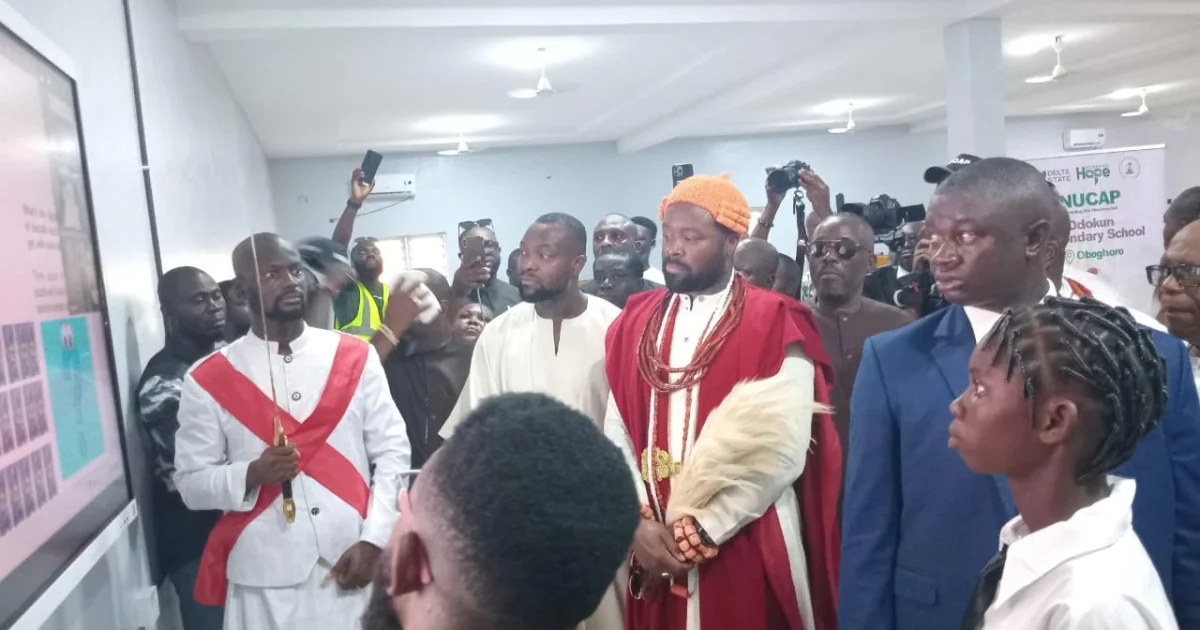
The Federal Government also donated more than 200 computers to Odo-Okun Secondary School, Oboghoro, to strengthen digital education and support the establishment of a Computer-Based Test centre for students preparing for the Unified Tertiary Matriculation Examination.
READ ALSO:
- 2027: Gombe APC targets one million votes for Tinubu
- Police kill two kidnappers in Delta gun battle
- Confederation of African Fashion targets $500bn fashion economy by 2036
The intervention is expected to ease the difficulties students in remote riverine communities face in accessing computer-based examinations and digital learning resources.
The Sole Administrator of Odo-Okun Secondary School, Monday Uyokpeyi, said the computers would improve students’ access to digital learning and strengthen the school’s capacity to prepare them for modern educational demands.
Speaking at the ceremony, Delta State Governor, Sheriff Oborevwori, represented by the Commissioner for Science and Technology, welcomed the intervention, saying improved telecommunications coverage would create opportunities for fishermen, traders, students and other residents.
He said the project aligned with the state’s MORE Agenda and would complement ongoing efforts to improve living conditions in rural communities.
“For our fishermen, traders and students, improved network coverage would create opportunities,” he said.
Also speaking, Seimode Benedict of Tantita Security Services Nigeria Limited commended the Federal Government for extending telecommunications services to the underserved communities.
He said reliable communication would improve residents’ livelihoods and strengthen safety and security operations in riverine areas, particularly around critical national assets.
Earlier, the Leader of Oboghoro Community, Dr Godwin Ebosa, described the commissioning as a significant milestone in efforts to connect riverine communities to the global digital economy.
He, however, urged the federal government to complement the telecommunications infrastructure with improved road access, particularly by including coastal communities in the proposed Lagos-Calabar Coastal Highway.
Ebosa also called on the government to revisit the highway’s original alignment to accommodate the Delta and Ondo State corridors.
“We are not just an integral part of the federation; we are without any breach of modesty, we are super critical stakeholders with immense value addition to the nation. also passionate about development. We respectfully request that you revisit the original plan and include our corridor,” he said.
The commissioning was attended by the Olu of Warri, Ogiame Atuwatse III, community leaders, government officials, representatives of the Itsekiri Grassroots Coalition and members of the President Bola Tinubu Door-to-Door Movement, among others.
The Delta intervention is part of the Federal Government’s wider effort to address Nigeria’s digital divide through NUCAP.
The programme is designed to deploy 3,700 communications sites nationwide, providing rural broadband access, public Wi-Fi and digital learning facilities to underserved and unserved communities.
The need for expanded connectivity is underscored by disparities in internet access between urban and rural areas.
The 2026 Nigeria Tech Outlook report by the National Information Technology Development Agency and the National Bureau of Statistics put internet use among urban adults at 55.7 per cent, compared with 29.5 per cent among rural adults.
The federal government’s National Broadband Plan also set a target of providing coverage to at least 80 per cent of the population by the end of 2027, with particular attention to underserved and unserved communities.
