

Bagudu Calls for Stronger Media, Legislative Oversight of National Budget
The Minister of Budget and Economic Planning, Senator Abubakar Bagudu, has called for stronger collaboration between the media and legislative oversight institutions to improve scrutiny of Nigeria’s national budget.
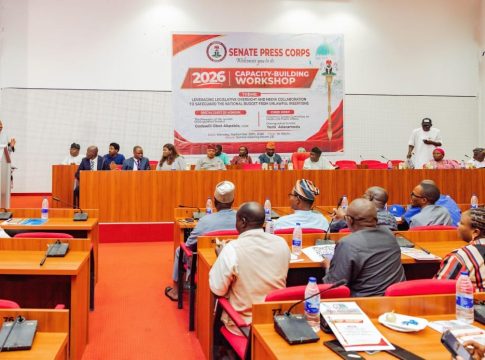
Bagudu made the call at the Senate Press Corps Capacity-Building Workshop, organised under the theme, “Leveraging Legislative Oversight and Media Collaboration to Safeguard the National Budget from Unlawful Insertion.”
He said the media has a significant role to play in ensuring accountability while helping Nigerians understand the constitutional and economic considerations behind the national budget.
According to the minister, effective budget scrutiny requires more than identifying provisions that appear controversial.
He urged journalists to investigate the background of individual allocations, understand the needs they are intended to address and examine the constitutional process through which they entered the budget.
Bagudu warned against reaching conclusions without sufficient information.
He said the fact that a budget provision is unfamiliar does not automatically mean that it is unlawful.
The minister cited water infrastructure in underserved areas and equipment for fishing communities as examples of provisions that could be misunderstood without local context.
However, he stressed that journalists should not allow the need for context to weaken their watchdog role.
He said vigilance was necessary because budget preparation and implementation involve human processes and are therefore susceptible to mistakes.
Bagudu called on both journalists and lawmakers to maintain close scrutiny throughout the budget cycle.
He also urged the public to develop a better understanding of the respective roles of the executive and National Assembly.
The minister said the National Assembly has a constitutional role in shaping and approving the national budget and that Nigerians should understand how the legislative and executive arms interact during the process.
Read Also: 2027 Polls: INEC Warns Staff Against Political Partisanship
He further called for a wider conversation about Nigeria’s fiscal capacity.
According to Bagudu, the country’s population and development needs place considerable demands on limited resources.
He said Nigerians should therefore consider how the country can mobilise additional revenue and increase the level of public investment required to meet its development objectives.
Bagudu connected these issues to the Renewed Hope Agenda and Agenda 2050, as well as the ambition to build a $1 trillion economy.
He said achieving the objective would require serious consideration of how Nigeria raises, allocates and spends public resources.
The minister also stressed the importance of public confidence in fiscal policy.
He said citizens’ understanding and support are necessary for major decisions involving taxation, government spending and borrowing.
Bagudu also addressed the debate over recurrent and capital expenditure.
He argued that recurrent expenditure should not automatically be regarded as less valuable because spending on security, education, healthcare, human capital and public-sector personnel can contribute directly to development.
He also noted that debt-service obligations must be met to prevent increased borrowing costs and possible consequences for private-sector operators.
On transparency, Bagudu called for balance where sensitive information could have implications for national security or strategic interests.
He urged journalists to continue demanding accountability while reporting budget issues within the broader context of Nigeria’s development needs.
According to the minister, economic transformation will require effective government action, informed citizens and innovative thinking.
He therefore challenged the media to help bring deeper fiscal and development conversations into the national discourse while maintaining rigorous oversight of public institutions.
