

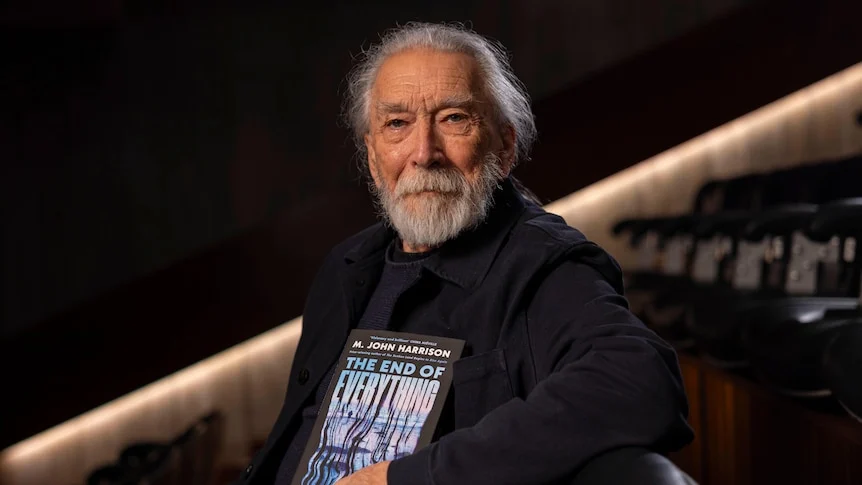
British author M John Harrison has won the 2026 Booker Prize for his dystopian novel, The End of Everything, becoming the oldest recipient of the prestigious literary award at the age of 81.
Harrison, known for his science fiction and fantasy works, received the £50,000 prize at a ceremony in London on Monday night.
According to Australia’s ABC News on Tuesday, his 13th novel was selected from 163 entries, beating five other shortlisted books to claim the award.
The End of Everything follows a man, Phillip Tennent, and his aunt, Marnie, who live in southern England decades after a mysterious invasion has led to the collapse of society.
The story begins when Tennent, a scavenger, discovers a mysterious object on a beach and takes it to his artist aunt, whose memory is failing.
The object, described as a biological gadget discarded by the invading iGhetti, appears to grow in size as Marnie examines it.
Speaking about the inspiration behind the novel, Harrison told the Booker Prize that the 2008 global financial crisis first prompted him to develop the story, while its themes and satire were shaped by contemporary affairs.
“What happens when all of our expectations and explanations of the world become an ongoing disaster, but we still have to make a life?” he said.
Accepting the award, Harrison said he had not expected to win and described the Booker as important in what he called a “landscape of industrialised fiction”.
“I really didn’t expect to be up here this evening,” he said. “I honestly didn’t, here at the end of everything.
“You talk glibly about your life being changed but it’s weird when it happens. I feel like a proper writer at last, totally lacking in confidence.”
He thanked his publisher, Serpent’s Tail, and his partner, editor Cath Phillips, for their support.
“No-one writes a novel alone. I’ve had so much support across the last 40 or 50 years that at this point my input seems to be the least of it,” he said.
Asked what message he hoped readers would take from the novel, Harrison described its world as grim but suggested it offered a measure of relief.
“It’s a grim world and it will keep on being grim,” he said.
READ ALSO:
- Police Rescue Six-Year-Old Kidnapped Boy and Arrest Two Suspects in Kaduna
- 41-Year-Old Arrested in Connection with Bayelsa Sand Dealer’s Death
- Apple Music names British singer Olivia Dean 2026 Artist of the Year
“But at the end of things there may be some kind of, I wouldn’t say hope or closure, but there might be some kind of relief.”
The chair of the Booker Prize judging panel, classicist Mary Beard, described the novel as “the politics of now seen through the lens of the future”.
She said the book explored how an apocalypse could make the world incomprehensible and render existing rules irrelevant.
“[The End of Everything is] a book that turns you upside down, raises a wry smile — and surprisingly, given the subject matter, leaves you with a twinge of optimism,” Beard said.
She added that the novel was unanimously selected by the judges, whose panel included Booker-shortlisted writer Patricia Lockwood and musician Jarvis Cocker.
Other books shortlisted for the 2026 award were The Disappearers by Marlon James, Black Bag by Luke Kennard, May We Feed the King by Rebecca Perry, The Things We Never Say by Elizabeth Strout and John of John by Douglas Stuart.
Harrison, whose writing career spans six decades, previously won the Arthur C Clarke and Philip K Dick awards for his 2006 novel, Nova Swing.
He was also a judge for the Booker Prize in 2022, when Shehan Karunatilaka won with The Seven Moons of Maali Almeida.
His victory highlights the growing recognition of science fiction and other genre-based works within mainstream literary awards.
Harrison said winning the Booker gave writers the freedom to work across literary categories without being restricted by labels.
“Winning the Booker gives you permission to be what you are without a label stuck on your forehead all the time,” he said.
“This book shows, and the prize now shows, it’s very possible to write a book which mixes not just two genres, but three or four … The concept of genres as pigeonholes is over.”
The Booker Prize was first awarded in 1969 and is open to works written in English and published in the United Kingdom or Ireland, regardless of the author’s nationality.
Previous winners include Salman Rushdie, Hilary Mantel, Richard Flanagan and David Szalay, who won the 2025 edition.
