

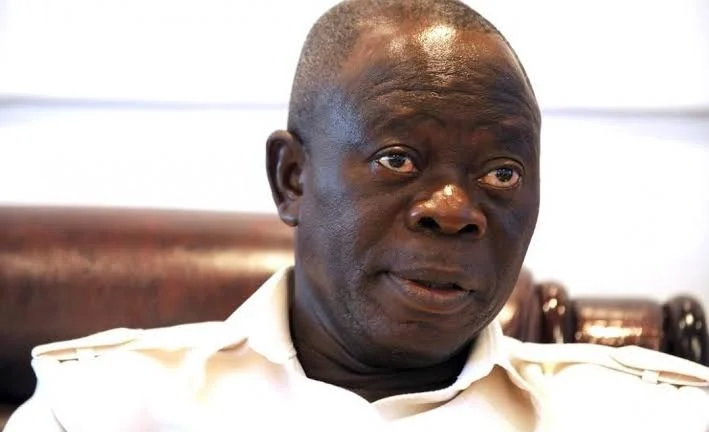
Former Edo State Governor, Adams Oshiomhole, has criticised former Vice-President Atiku Abubakar’s advocacy for the privatisation of tertiary education, saying Nigeria cannot afford such a policy when millions of children are still out of school.
Oshiomhole spoke on Monday in Abuja at the unveiling of the Renewed Hope Education A+Z Scorecard by the Minister of Education, Dr Tunji Alausa.
He recalled that Atiku pursued a privatisation agenda while serving as Vice-President, questioning the rationale behind his advocacy for private-sector control of tertiary education in a country where access to basic education remains a major challenge.
The former governor also challenged opposition politicians, particularly Atiku and former Anambra State Governor Peter Obi, to clarify whether they would retain or abolish the current education policies if elected into office.
Oshiomhole further criticised Atiku over comments he attributed to the former Vice-President concerning the use of public resources to enrich friends, arguing that such an approach could undermine funding for education and student support programmes.
“If the money he wishes to use to enrich his friends is not diverted to paying student grants, remember that resources are limited at any point in time. That is why economics is about priorities. What is given to those students will not be available to be used to assist friends,” he said.
Nigeria’s education sector continues to face challenges, including inadequate infrastructure, teacher shortages, poor learning outcomes and unequal access to schooling.
A 2024 UNICEF estimate put the number of out-of-school children in Nigeria at 18.3 million, comprising 10.2 million primary school-age children and 8.1 million of junior secondary school-age children. However, the Federal Ministry of Education has used a more recent estimate of about 15 million.
The Federal Government has introduced interventions to address the challenges, including the Nigerian Education Loan Fund, the Technical and Vocational Education and Training programme, the Nigeria Education Data Infrastructure and initiatives targeting out-of-school children.
READ ALSO:
- Tinubu’s education reforms yielding results — Alausa
- Obi says his Anambra governance model can work in Nigeria
- FG unveils digital plan to tackle teacher shortage, out-of-school children
According to the Federal Ministry of Education’s Nigeria Education Sector Renewal Initiative 2026 report, NELFUND had processed more than 1.65 million applications and disbursed N372.62bn in student loans, covering tuition and upkeep allowances across 319 tertiary institutions.
The government also reported that 156,446 verified trainees had benefited from its TVET programme, which provides free vocational training, monthly stipends and start-up support.
In a related development, the Federal Government on Monday unveiled a National Education Technology Strategy aimed at addressing teacher shortages, improving access to learning and strengthening education data management through digital platforms.
The strategy is expected to integrate 26 government initiatives into a coordinated system covering digital learning, teacher development, education financing and interventions for out-of-school children.
Earlier, Alausa said the Federal Government had provided funding arrangements for its education data infrastructure and introduced a three-year renegotiation window in its agreement with the Academic Staff Union of Universities and other university-based unions.
He said the agreement could be reviewed every three years to prevent prolonged disputes over staff welfare and remuneration.
The Federal Government had in October unveiled new agreements with academic and non-academic staff unions in tertiary institutions, providing for improved welfare packages, allowances and a monitoring framework to ensure implementation.
The three-year review provision was also designed to encourage regular engagement between the government and the unions and reduce recurring industrial disputes that have disrupted academic calendars in public universities.
The Minister of State for Education, Prof Suwaiba Said Ahmad, said the ministry was also strengthening the education system through guidelines for appointing vice-chancellors, rectors and provosts, as well as policies addressing bullying in schools.
