

The Lagos State Government has admitted that key infrastructure projects at the Lagos State University of Education remain incomplete, including two 750-seat auditoriums and the reclamation of swampy sections of its Oto/Ijanikin campus, as the institution graduated its first 2,486 students on Thursday.
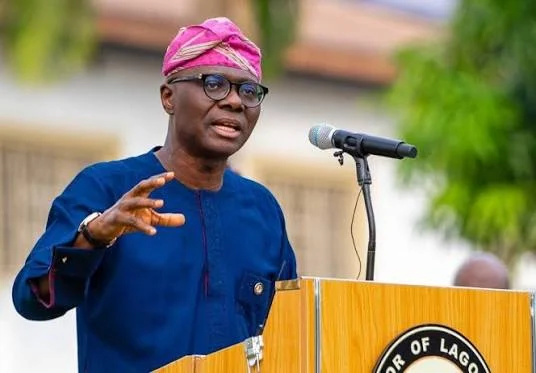
Governor Babajide Sanwo-Olu disclosed the outstanding projects at the university’s maiden convocation, nearly five years after he signed the law establishing the institution from the former Adeniran Ogunsanya College of Education and Michael Otedola College of Primary Education.
The governor, who is due to leave office on May 29, 2027, said his administration would complete what it could before handing over the remaining projects to its successor as unfinished work.
“The rest is not finished. Two auditoriums of 750 seats, one here and one at Epe, are not complete. Specialised teaching facilities are still needed. Much of the land on this campus still has to be drained and reclaimed. I will not pretend that the list is short,” Sanwo-Olu said.
His admission came as he commissioned the university’s Senate Building and disclosed that new lecture theatres and academic buildings had been constructed on its two campuses, while a new salary structure for staff had been introduced.
“In the months I have left, we will do what we can on that list. What we do not finish will be handed over, properly recorded, as work in progress,” he said.
The outstanding projects raise questions about the funding and completion timetable for infrastructure at the specialised university, particularly as it begins producing graduates and expands its student population.
Sanwo-Olu said the institution, established by a law he signed on February 2, 2022, had grown from two colleges without a university structure into an institution with more than 15,000 students, 49 full professors and 66 academic programmes that received full accreditation from the National Universities Commission in 2024.
He said 2,486 students graduated at the first convocation, while others received diplomas and certificates.
The governor explained that the conversion of the two colleges into a university was intended to address declining interest in teaching, which he attributed partly to the disparity in qualifications between prospective teachers and graduates pursuing other professions.
“A young person in Lagos who wanted to teach went to a college and came out with a certificate. A young person who wanted to do almost anything else went to a university and came out with a degree. Students and their parents drew their own conclusion, and enrolment suffered. Then we complained that our brightest young people no longer wanted to teach,” he said.
He added, “We decided to stop complaining and change the offer. A society shows what it thinks of its children by what it requires of the people who teach them. We decided that the person who teaches a six-year-old to read should be educated to the same level as the doctor who will treat that child, or the engineer who will build the road to her school.”
The institution was created by merging the former Adeniran Ogunsanya College of Education in Oto/Ijanikin and the Michael Otedola College of Primary Education in Epe, both of which had trained teachers for decades.
Sanwo-Olu said 3,300 pioneer students matriculated in 2023 after being selected from more than 8,000 applicants, despite the institution having no previous graduates whose qualifications prospective students could assess.
READ ALSO:
- Lagos, Enugu, Ogun account for 54% of states’ IGR
- BOI earmarks 10% of funding for green projects
- Fidelity Bank appoints Amuchie as new managing director
He said the university’s first graduating set included 84 first-class degree holders, with Blessed Mercy Olawunmi of the Department of Home Economics emerging as the best graduating student with a cumulative grade point average of 4.98.
The governor warned the university’s management against compromising academic standards, particularly as it builds its reputation as a new institution.
“Do not lower the standard for anyone. Not for a Governor. Not for a Visitor. That is the only way to honour a name on a wall,” he said, referring to the Senate Building named after him.
Sanwo-Olu also urged the pioneer graduates to protect the institution’s reputation, saying employers and parents would judge the value of its degrees by the performance of its first graduates.
“For the next ten years, you are its reputation. When an employer or a parent asks what a LASUED degree is worth, the answer will be the last LASUED graduate they met. Make sure it is a good answer,” he said.
He further argued that the growing use of artificial intelligence in education made professionally trained teachers more important, not less, because technology could not replace the human ability to identify and respond to a child’s emotional and learning difficulties.
“The machine will answer the child who asks. It will not notice the child who has stopped asking. It will not know that she is hungry, or afraid, or that she has decided school is not for people like her. Only a teacher sees that,” he said.
The governor acknowledged concerns about the remuneration of teachers, saying teaching was not the best-paid career graduates could pursue and that governments, including his administration, had a responsibility to narrow the gap.
He said the importance of the institution extended beyond Lagos, citing UNESCO’s estimate that sub-Saharan Africa would need an additional 15 million teachers by 2030.
Sanwo-Olu said the university was intended to strengthen the supply and quality of teachers for Lagos and provide an example for the country.
He recalled that the Lagos State House of Assembly passed the establishment bill on November 15, 2021, before he signed it into law in February 2022.
The governor said the institution’s development was the product of the work of the Assembly, the university’s governing council, management and staff, rather than his administration alone.
He is expected to hand over the institution’s visitorial role to his successor when he leaves office next May, saying the university must be able to function beyond the tenure of the government that established it.
