

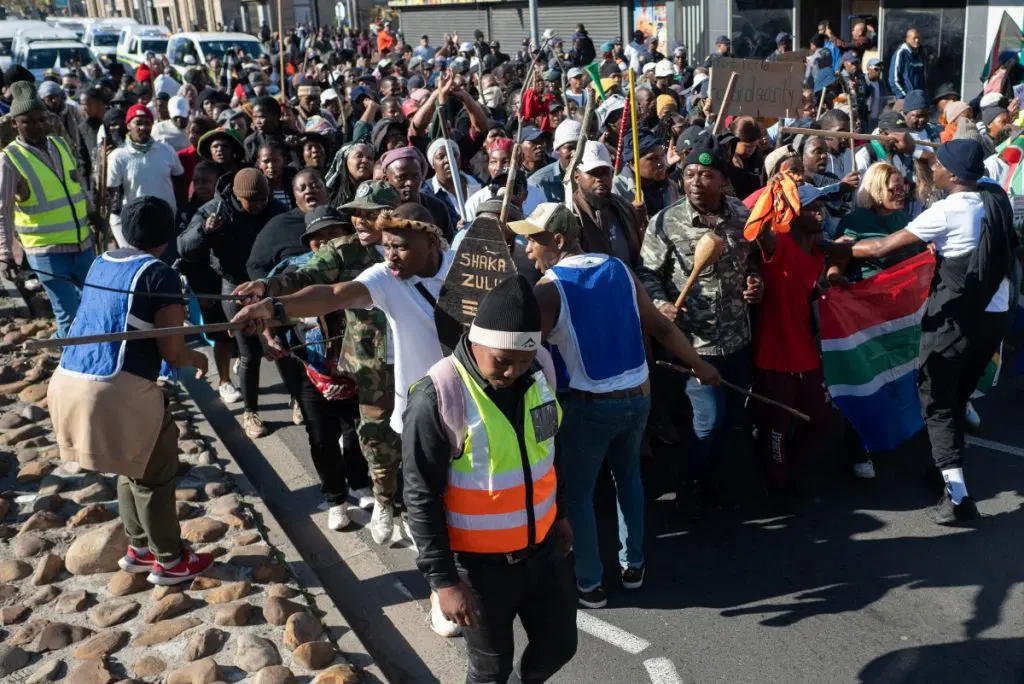
President Bola Ahmed Tinubu has called for a continental coordinated response to the recent xenophobic attacks on Nigerians and other African nationals in South Africa, urging the Economic Community of West African States (ECOWAS) to bring the matter before the African Union (AU).
Reports say the President made the appeal at the 69th Ordinary Session of the ECOWAS Authority of Heads of State and Government in Lungi, Sierra Leone, where he was represented by Vice President Kashim Shettima.
Speaking to regional leaders, Tinubu decried what he called Afrophobic attacks on Nigerians and other Africans living in South Africa.
“Nigeria condemns in the strongest terms the recent Afrophobic attack on its citizens and other fellow Africans in the Republic of South Africa.
“As the President of Ghana, His Excellency, has already said, ECOWAS should take this issue to the next meeting of the Authority of the African Union and send a strong message that this kind of behaviour is not acceptable,” he said.
The President also reminded South Africa of the support it received from other African countries in its struggle against apartheid.
He added: “We should remind South Africa that the freedom it is enjoying today is a consequence of the liberation efforts of African countries like Nigeria.
Tinubu said the Nigerian Government had evacuated 1,490 citizens from South Africa in 7 batches and was still ready to engage further on the issue.
The President’s stance came days after the Minister of Foreign Affairs, Bianca Odumegwu-Ojukwu, suggested Nigeria could consider retaliatory action over the attacks.
She had also said that the National Assembly would make recommendations on the matter.
The Senate and the House of Representatives have already condemned the attacks against African nationals and are assessing the situation.
Senior Advocate of Nigeria, Femi Falana, also recently called on the Federal Government to sue South Africa at the African Court.
On the xenophobia issue, Tinubu reaffirmed Nigeria’s commitment to the newly adopted ECOWAS Compact for the Future of Regional Integration, describing it as a strategic roadmap for promoting regional unity, economic cooperation, democratic governance and sustainable development.
He said: “As the largest economy and one of the key founding members of our Regional Economic Community, Nigeria remains committed to its historic responsibility to continue to promote regional unity, peace, economic integration and democratic governance.
He assured member states that Nigeria will continue to work with regional partners to implement the compact and achieve its strategic objectives.
The President also reiterated Nigeria’s commitment to removing barriers to trade, improving cross-border infrastructure and facilitating the free movement of people, goods and services across West Africa.
Read Also: Made-in-Nigeria Vehicles With 60% Local Content Excite Osanipin as LAFBART Unveils New Models
On democratic governance, Tinubu said insecurity and political instability remained major obstacles to development across the sub-region.
He reiterated Nigeria’s commitment to constitutional democracy, rule of law, respect for human rights and opposition to unconstitutional changes of government.
He warned, however, that poor governance and manipulation of constitutional provisions were equally capable of creating political instability.
“More than adventurism, the best weapon to use against unconstitutional change of government and mass protests that threaten to upset the public order is for us to enthrone good governance that will afford our people more tangible benefits.
He said, “We must also resist the temptation to tinker with constitutional term limits or to manipulate constitutional processes.”
“Tinubu also reiterated Nigeria’s support for the proposed ECOWAS Counter-Terrorism Force and efforts to strengthen the ECOWAS Standby Force through improved intelligence sharing, joint military operations and preventive diplomacy.
He further pledged Nigeria’s commitment to advancing gender equality, broadening opportunities for women leaders, investing in education and skills development, championing youth entrepreneurship and empowering youth throughout the region.
On relations with the Alliance of Sahel States, the President underlined the importance of dialogue and sustained engagement to maintain regional unity and to strengthen ECOWAS.
President Julius Maada Bio, host of the summit, said it was an opportunity for leaders to assess the bloc’s achievements and chart a new course for West Africa.
He said ECOWAS Vision 2050 was a roadmap for building a peaceful, prosperous and integrated region anchored on democratic governance and driven by innovation.
President of the ECOWAS Commission, Dr Omar Alieu Touray, said the commission had reinforced democratic governance, electoral assistance, regional security cooperation and humanitarian interventions.
He also pointed to progress on major regional infrastructure projects such as the African Atlantic Gas Pipeline and the Abidjan-Lagos Corridor Highway Project, saying they are critical to West Africa’s long-term economic integration and development.
