

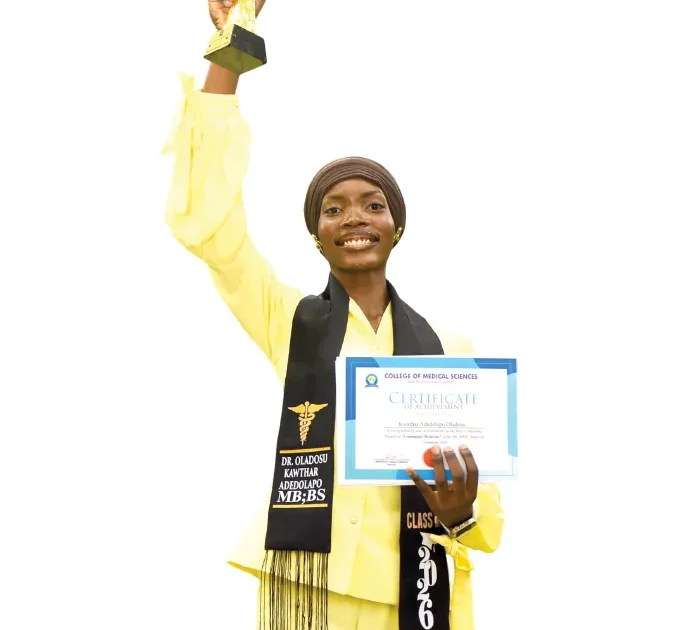
Oladosu Adedolapo emerged as Edo State University’s overall best graduating student in Medicine and Surgery. She speaks with TEMITOPE ADETUNJI about her academic journey, challenges and aspirations in medicine
What was growing up like for you?
I am the third of four children born to parents of modest means who worked hard to give me the best education.
My upbringing played an important role in shaping my values, particularly the importance of hard work, discipline, perseverance and faith. My background and the people around me have contributed significantly to how I approach life, my education and relationships with others.
Why did you choose to study Medicine and Surgery?
My parents often tell me stories about how I always wanted to become a doctor, although I barely remember those early experiences. The dream stayed with me as I grew older, and my interest in Medicine and Surgery increased when my elder sister began studying the course.
I have always considered medicine a unique profession because it combines scientific knowledge with compassion, service and the opportunity to help people during vulnerable moments.
I gained admission to study Medicine and Surgery at Edo State University, Iyamho, in 2020. I am grateful to have actualised that childhood dream.
Why did you choose the university for your medical training?
Making that choice was an important decision in my academic journey. At 15, my parents and I were looking for a Nigerian university that offered Medicine and Surgery, had standard facilities and did not impose an age restriction, as many institutions do not admit candidates younger than 16. My elder sister was also enrolled at the university.
We wanted an environment where I could receive quality medical training, develop essential clinical skills and become a competent and compassionate doctor.
My experience at Edo State University contributed significantly to my professional development and personal growth. I am grateful for the opportunity to train there and complete this important stage of my journey.
When you started medical school, what were your expectations?
I knew it would be challenging, but I imagined the process would be more straightforward. I expected to study hard, attend lectures, prepare for examinations and acquire the knowledge needed to become a doctor.
However, I soon realised that medical school required more than academic intelligence. The volume of information was enormous, expectations were high, and I had to learn how to study efficiently, manage my time and remain consistent, even when tired.
What was the most challenging period of your medical training?
The most challenging aspect of my medical training was transitioning into clinical studies after my first MB examination in 400 level. It felt like starting an entirely new phase, with unfamiliar courses and terminology. I began with introductory clinical postings, followed by pathology and pharmacology, and felt as though I had entered a whole new world.
Medical school involved ward rounds, clinics, clerking and presenting patients, hospital practice and extensive studying. Balancing the volume of information with the need to apply it clinically was challenging. I had to understand diseases, their presentations, investigations and management rather than simply memorise facts.
I overcame this by staying focused, taking things one step at a time, remaining consistent, remembering my goals and seeking guidance from experienced senior colleagues.
Was there ever a point when you felt overwhelmed or doubted your ability to complete the programme?
There were periods when I felt overwhelmed by the workload, expectations and pressure to perform, but I never doubted my ability to complete the programme.
Medical training can make you feel that there is always more to read, learn and improve on. During such moments, I learnt to focus on what I could achieve at that particular time, remind myself of how far I had come and take things one step at a time.
Medical school is demanding. How did you manage your studies, clinical postings, examinations and personal life?
Managing medical school required planning, discipline and flexibility. I learnt not to rely on motivation alone but to develop consistent habits, even when I was tired.
I maximised my study time, kept up with academic responsibilities, prepared systematically for examinations and balanced theoretical knowledge with practical patient care during clinical postings. I also made sure I read daily, regardless of how little time I had.
Maintaining a personal life was challenging, especially during examinations, but I recognised the importance of rest and relationships. I learnt to adjust to each stage of my training and make the best use of the time and resources available to me.
What sacrifices did you make to remain focused on your studies?
One of the biggest sacrifices was making difficult decisions about how I spent my time. Sometimes, I had to miss social activities, postpone personal plans or study instead of resting.
Other sacrifices included the mental effort required to understand new information, prepare for examinations and meet academic expectations.
However, the journey was not entirely about what I gave up. I also gained discipline, resilience, knowledge and a better understanding of myself.
How did you feel when you learnt that you had emerged as the Best Graduating Student in Medicine and Surgery?
It was a special moment, and I felt elated. Being recognised as the Best Graduating Student in Medicine meant a lot to me because I understood the hard work, commitment and perseverance involved.
I was not entirely surprised because I had always tried to give my best academically while focusing on learning, preparing for examinations and completing each stage of my training.
The recognition was exciting and humbling. It reminded me that consistency makes a difference over time, even when the results are not immediately visible.
Could you clarify how the Best Graduating Student in Medicine award was determined?
It was based on overall academic performance.
What do you think contributed most to your academic performance throughout medical school?
It came from consistency, discipline, determination and a genuine commitment to understanding what I studied.
The volume of information required sustained effort and continuous learning. Understanding concepts rather than relying entirely on memorisation was important because medicine involves connecting information, recognising patterns and applying knowledge clinically.
I also appreciate the support of my parents, siblings and friends, who encouraged me to keep improving.
Ultimately, consistency was particularly important. Making deliberate and sustained efforts to improve and continue learning can make a real difference.
Did you have a particular study routine or approach that helped you cope with the demands of medical training?
My approach centred on understanding the material, revisiting it regularly and identifying areas that needed improvement. I learnt that spending long hours with books did not necessarily translate into effective learning.
I focused on understanding concepts rather than memorising information without context. I revisited difficult topics and tested my understanding instead of assuming that reading something once meant I had mastered it.
My approach evolved throughout medical school because the demands of the preclinical and clinical years were different.
Who were the people who supported you throughout the journey?
My medical school journey was not completed alone. I am grateful to my family for their support, encouragement and sacrifices, which helped me pursue my education and remain focused.
I appreciate my lecturers and doctors whose guidance and knowledge shaped my development.
My friends also played an important role. Having people who understand the experience makes a difference because we learn from one another, offer encouragement and provide support through our presence.
Beyond academics, what experience during your medical training had the greatest impact on you?
One of the most important lessons I learnt during clinical training was that medicine is not just about identifying diseases and prescribing treatment. It also involves understanding people, communicating effectively and recognising their fears and concerns.
Interacting with patients taught me that even routine medical conditions can be deeply distressing. I learnt the importance of empathy, patience and respect, recognising that how medical knowledge is communicated and applied influences a patient’s experience.
These experiences reinforced my understanding that becoming a doctor requires more than clinical competence; it also demands the right attitude towards patients and an appreciation of the trust they place in us. I hope to carry these lessons forward in my career.
Having completed your MBBS programme, what does this achievement mean to you personally?
It means a great deal to me. It represents years of hard work, learning, sacrifice and personal growth.
Reflecting on the journey, I appreciate both the academic achievement and the person I have become. Being recognised as the Best Graduating Student in Medicine makes it even more meaningful.
However, I see graduation as the beginning of another important stage, not the end of my learning journey.
What area of medicine would you like to specialise in?
I am currently evaluating my options, and I would like to rotate through different specialties during my housemanship so that I can make an informed decision.
I also recognise that medical training is a continuous process of exploration and development. I want to keep learning, gain more clinical experience and make an informed decision as I progress in my career.
From your experience as a medical student, what do you think needs to improve in Nigeria’s healthcare system?
I believe Nigeria’s healthcare system needs sustained improvements in infrastructure, funding, staffing, access to essential medicines and the distribution of healthcare professionals.
Strengthening primary healthcare is essential because it is the first point of contact for many people. Effective primary healthcare improves disease prevention, early diagnosis and the management of common conditions.
Access to affordable healthcare must also improve. Strengthening health insurance and ensuring that vulnerable populations can access services would help prevent financial difficulties from delaying medical attention.
Improving healthcare professionals’ working conditions through adequate equipment, professional development, fairness and supportive environments is equally important.
We must also strengthen medical education, research and evidence-based practices.
These challenges require sustained investment, effective leadership, accountability and collaboration among the government, healthcare professionals, institutions and communities.
As a young doctor, I hope to contribute to these improvements in whatever capacity I can.
What would you say to students who are struggling with medical school or feel discouraged because they are not among the top performers in their class?
Your academic position does not determine your worth or the kind of doctor you can become. Medical school is demanding, and students have different strengths, learning styles, circumstances and rates of development.
Focus on understanding the material, improving consistently and identifying what works best for you rather than comparing yourself with others.
If you struggle, identify the problem. It may be your study method, time management, understanding of certain subjects or need for rest and support. Seek guidance from lecturers, colleagues, mentors or trusted people.
Do not allow a disappointing examination result to convince you that you are incapable of succeeding. Learn from the experience, adjust your approach and keep moving forward.
Looking ahead, what are your plans after graduation, and what kind of doctor do you hope to become?
I want to develop my clinical knowledge and skills, gain practical experience and prepare for the next stage of my medical career.
This begins with completing my mandatory one-year housemanship, followed by the National Youth Service Corps.
In the long term, I hope to pursue postgraduate training and become a doctor who combines clinical excellence with empathy, integrity and lifelong learning.
Ultimately, I want to be a doctor whom patients trust, colleagues can rely on, and younger medical students can look up to. I want my career to be defined not only by professional achievements but also by the positive impact I make on people’s lives.
For me, this achievement is not the finish line but the beginning of a lifelong commitment to learning, service and contributing meaningfully to medicine.
