


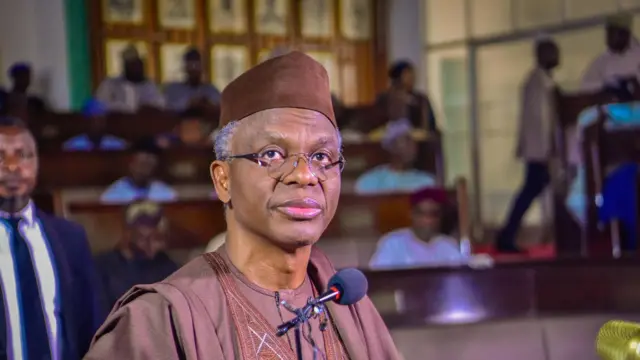
Former Kaduna State Governor, Nasir El-Rufai, has denied allegations of abuse of a court-approved medical visit while in custody by the Independent Corrupt Practices and Other Related Offences Commission (ICPC), accusing the anti-graft agency of misrepresenting the facts and the law regarding the incident.
The former governor also demanded the immediate release of his personal physician, Professor Bello Abubakar and urged the ICPC to withdraw its allegation that he violated a court order.
El-Rufai’s media adviser, Muyiwa Adekeye made the demands in a statement on Wednesday in response to the ICPC’s July 7 statement titled, “El-Rufai and Medical Doctor Abuse Privilege, Violate Court Order.
The commission’s account was not accurate, Adekeye said, as El-Rufai’s failure to appear in court on July 6 was due to an unresolved medical condition that was brought to the attention of the ICPC before the scheduled court proceedings.
The statement said the personal physician to El-Rufai had first tried to examine the former governor at the ICPC facility after having discussions with the commission’s doctor.
It claimed Abubakar was denied access to his patient after waiting for over two hours.
In the statement, it said the family of El-Rufai later wrote to the ICPC to take him to the National Hospital, Abuja to see his physician on July 7.
It insisted the request was made before the family was informed of El-Rufai’s scheduled court appearance on July 6.
“It was against this backdrop – an unmet medical need, a documented denial of access to his physician a week ago and the continued ill health of Malam El-Rufai – that the planned trip to Kaduna on 6th July became untenable. He did not travel on that day for that reason,” the statement said.
El-Rufai’s camp also refuted the ICPC’s claim that the former governor had no immediate medical complaints and that he only sought access to his doctor after a request by his wife.
Adekeye rejected the commission’s account as false, saying the medical consultation was not invented to keep El-Rufai from appearing in court.
“The suggestion that he had ‘no immediate medical complaints’ on 6th July, or that the request to see his doctor was fabricated to avoid court, is therefore untrue,” he said.
The statement said that El-Rufai’s medical condition was not resolved before the planned trip to Kaduna for the court case.
Adekeye also defended the ICPC’s allegation that El-Rufai breached a court order by visiting the hospital.
The order given was in the words of Justice R.M. Aikawa on April 1, 2026 in Charge No. FHC/KD/73C/2026.
The order allowed the former governor to obtain medical care while in custody and did not limit who could visit him during a medical appointment, he said.
He said the court order “does not regulate, restrict or impose conditions upon who may see or be seen by him while that access is being exercised.
But El-Rufai’s group maintained that the order concerning the hospital visit was not violated.
The former governor’s media team also disputed the commission’s characterization of the hospital visit as a political rally.
Adekeye said the ICPC changed the time of the medical appointment from 5pm to 10am, when the hospital was busier and did not tell El-Rufai’s family of the change until the morning of the visit.
“It was the Commission that shifted the appointment from a quiet 5:00pm slot to a high traffic 10:00am slot… and it was the Commission’s own personnel who were placed at the scene throughout,” the statement said.
The former governor’s camp said the events that occurred were not in line with the commission’s claim that the medical visit was used to organise a political meeting.
Adekeye also condemned the arrest of Abubakar, El-Rufai’s personal physician, calling on the ICPC to publish the alleged false statement for which the medical practitioner was arrested.
“We demand the immediate and unconditional release of professor Abubakar pending the ICPC’s disclosure of the specific allegation against him,” said the statement.
The El-Rufai camp said medical treatment is a legal right and not a privilege.
The statement cited the United Nations Standard Minimum Rules for the Treatment of Prisoners, otherwise known as the Nelson Mandela Rules, and the subsisting court order in support of its position.
It warned that any attempt by the ICPC to deny El-Rufai access to medical care, his family or legal representatives may be considered contempt of court.
“The timeline does not support the conclusion that the medical appointment was used to stage a political meeting,” the statement read.
