

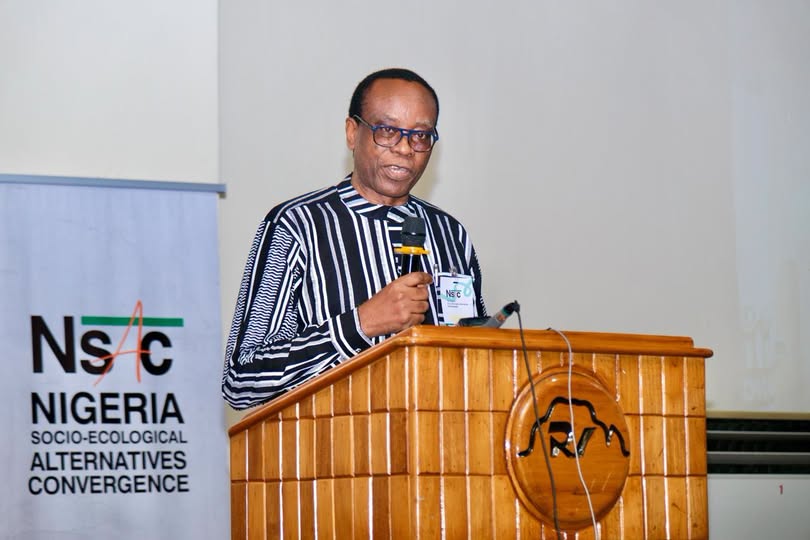
Participants at the Third Nigeria Socio-Ecological Alternatives Convergence (NSAC) have warned the country against repeating the environmental and governance mistakes that have marked decades of oil and gas exploitation as it seeks to benefit from the growing global demand for critical minerals.
The warning came in a communiqué issued at the end of the convergence organised by the Health of Mother Earth Foundation (HOMEF) and partner organisations in Abuja under the theme, “Deforestation, Mining and the Crisis of Human Security in Nigeria.
The gathering brought together government representatives, traditional institutions, academics, civil society organisations, labour unions, frontline communities, youth and women groups, development partners and environmental justice advocates to discuss the implications of the expanding extractive sector and global energy transition.
The participants said the growing demand for critical minerals for renewable energy technologies, batteries and electric vehicles, offered huge opportunities for economic growth and industrial development in Nigeria.
But they warned that without strong environmental safeguards, transparent governance and community participation, the rush for critical minerals could lead to a new cycle of exploitation similar to what happened in the country’s oil producing regions.
The communiqué said while the world is transitioning toward cleaner energy sources, there is growing concern that the extraction of minerals needed for that transition may come at a heavy environmental and social cost if not properly regulated.
Mining expansion in Nigeria is already occurring against the backdrop of weak environmental governance, weak regulatory enforcement, illegal mining activities, lack of monitoring and limited institutional capacity, participants said.
They said host communities continue to pay environmental, social and health costs associated with extractive activities, while receiving little in the way of benefits from the resources taken from their territories.
The convergence also showed that forests, wetlands, farmlands and other vital ecosystems are increasingly under threat from mining operations, logging, land acquisitions and poorly regulated development activities.
Participants warned that environmental degradation, illegal mining and climate-related pressures are causing displacement, food insecurity, organized crime and deteriorating socio-economic conditions in many communities across the country.
The conference also worried that community consent, customary land rights and meaningful public participation are not yet adequately protected, leaving vulnerable populations exposed to environmental and economic risks.
In his keynote address, Prof. Omolade Adunbi, discussed the nexus between critical minerals, decarbonisation and energy transition, called on policy makers to ensure that Nigeria does not sacrifice ecological sustainability and community welfare in the name of economic gains.
One of the experts who made presentations at the convergence was renowned environmentalist, Nnimmo Bassey, who advocated a development model that prioritises people, ecosystems and long-term sustainability over short-term profits.
Participants called for a National Just Energy Transition and Critical Minerals Strategy grounded in transparency, accountability, environmental protection and community development to avoid the mistakes of the oil and gas sector.
Read Also: Shettima: The Easiest Way To Anger Tinubu Is To Criticise Buhari
They also demanded better enforcement of environmental and mining laws, strengthening of regulatory institutions and strong action against illegal mining and logging activities in the country.
One key resolution adopted was the call for mandatory application of Free, Prior and Informed Consent (FPIC) for all projects affecting indigenous peoples and host communities, along with the recognition of customary land rights and equitable benefit-sharing mechanisms.
The communiqué also called for independent Environmental and Social Impact Assessments, restoration bonds, mine closure plans, regular environmental audits and public disclosure of licences, contracts and beneficial ownership information within the extractive sector.
They also equally called on the government and industry stakeholders to promote domestic value addition, technology transfer, local content development and sustainable formalisation of artisanal mining to ensure broader economic benefits for Nigerians.
The convergence reached the conclusion that Nigeria’s transition to a low-carbon economy should be people-centred, rights-based and environmentally sustainable. Participants stressed that the country’s mineral wealth should serve the interests of communities and future generations, and not become another chapter in the history of environmental degradation and resource-driven inequality.
