

Nigeria is stepping up efforts to address insecurity thru closer collaboration among security agencies, governments, communities and citizens, with a renewed focus on intelligence gathering, public education and coordinated surveillance.
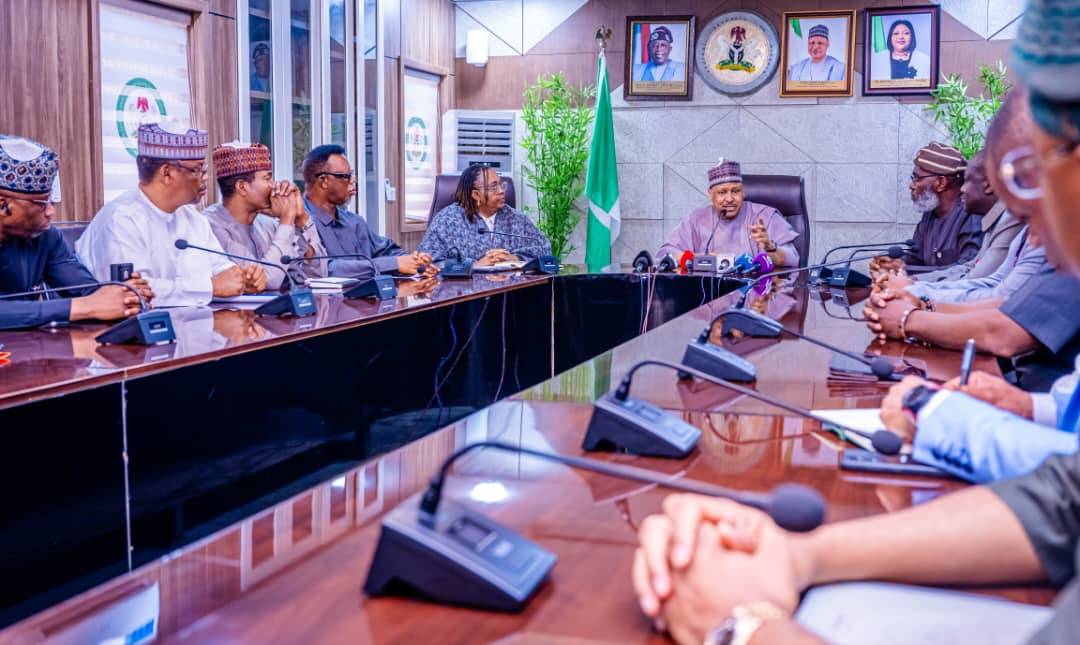
This was made known by the Minister of Information and National Orientation, Mohammed Idris when he received the Special Adviser to the President on Homeland Security, Major General Adeyinka Famadewa and his team on a courtesy call to his office in Abuja.
The Minister stated that Nigeria could not solely depend on military might to achieve lasting peace, pointing out that effective intelligence gathering and surveillance needed the active involvement of citizens because security agencies could not be physically present in every community.
“The security situation in this country or anywhere in the world is such that there must be collaboration between the security agencies, the armed forces and the general public,” the Minister said.
Idris said peace and security still remained the bedrock of economic development, adding that the Federal Government’s aspiration of attaining prosperity for Nigerians could not be achieved without a secured environment.
‘No development can ever happen if there is no peace. Security and peace are important elements. In fact, they are the building blocks of any development that can take place anywhere,” he said.
Read Also: INEC Begins Distribution Plans as Osun Election Materials Arrive at CBN
The Minister also reiterated the Ministry’s commitment to collaborate with the Office of the Special Adviser on Homeland Security toward enhancing public awareness on national security issues and encouraging citizens to provide useful information to security agencies.
The National Orientation Agency (NOA) has more than 800 offices and over 5,000 personnel across the country, he said.
The agency’s presence at the grassroots level gives it access to communities and individuals who can provide valuable information for security planning and intelligence gathering, he said.
“They are living in among the communities. “They live with vulcanizers, groundnut sellers, traditional rulers, market women, teachers, students, everybody,” Idris explained.
The Minister said information obtained thru such interactions could assist security authorities in gaining a better understanding of developments within communities and in responding more effectively to emerging threats.
He also called for collaboration in surveillance between the Federal Government and state governments as criminals and terrorists often exploited state boundaries to evade security operations.
“Surveillance cannot be done by a single state alone. There is not one state government. “Even the federal government alone cannot fight this. “We need to come together, co-ordinate,” the Information Minister emphasized.
Idris said the recent rescue of abducted schoolchildren in Oyo State was an example of the benefits of stronger coordination among security agencies, the armed forces and local communities.
He said the development showed how better intelligence gathering and working with the citizenry could bolster the government’s response to security incidents.
The Minister also urged the media to give greater prominence to the successes and sacrifices of the armed forces and other security personnel in the fight against terrorism, banditry and other criminal activities while eschewing reports that unnecessarily glorify criminals.
“Terrorists, criminals, bandits, all these people that mean us ill are enemies of each and every one of us. We should treat them like it. Let’s have a celebration. “We need to strengthen our armed forces by reporting the successes they have made in their fight against insecurity,” he said.
Idris also named fake news, misinformation and disinformation as major security concerns especially as the 2027 general elections draw near. He said the Ministry was expanding media and information literacy programs to help Nigerians identify credible information and reject false reports capable of causing panic or undermining security operations.
“Being educated is not enough, you also have to be media literate to be able to discern what is fake news and what is bad,” Idris said.
The Special Adviser to the President on Homeland Security, Major General Adeyinka Famadewa, said his office was looking for a structured partnership with the Ministry because public education has become a critical component of national security.
He said that threats like artificial intelligence, disinformation, propaganda and perception management demand a more proactive strategy for information management.
“Now, public information or public education is not just the media like it was before. “It’s a key capability that we need for Homeland Security,” he said.
The establishment of the new office was to complement existing security institutions and not to replace them, Famadewa said.
He identified four immediate priorities of the office: the creation of a unified national intelligence and surveillance program, border security, anonymity and protocols for reporting and responding to security incidents.
“I will here emphasize that the office is to complement, not to replace any office. Here’s the thinking. “No land in Nigeria should be left unmonitored. We should be able to see what is going on, who is moving and what they are doing,” the Special Adviser said.
Famadewa also called for the development of an incident-reporting platform and stronger community resilience thru national orientation, stressing that Nigeria could not depend on military force alone to overcome insecurity.
It is difficult to shoot ourselves out of insecurity. “But it is easier for us to build the strength of the nation that the man that wants to perpetrate violence has some level of resistance from the society,” he noted.
Every Nigerian, the Special Adviser said, was a potential source of security intelligence and he urged citizens to be vigilant and report suspicious activities.
“National security is not anyone’s job. It is the work of every Nigerian. Each Nigerian is a sensor. And if we optimize the sensor ability of every Nigerian, then we will have a better society,” he said.
The officials expressed confidence that enhanced collaboration among the information sector, security agencies and communities would strengthen Nigeria’s response to insecurity and support sustainable national development.
