

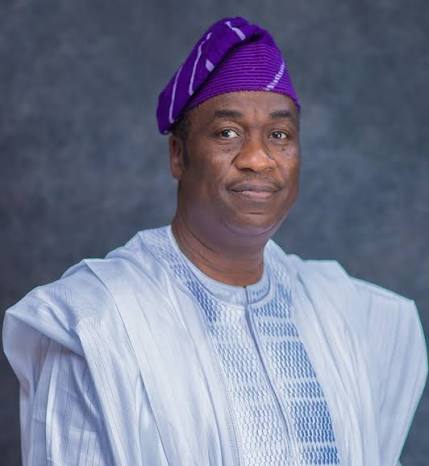
The 2027 Lagos State governorship election looks set to be a major contest between a powerful political establishment and an increasingly assertive opposition. The race is already attracting significant attention, with All Progressives Congress’ Obafemi Hamzat enjoying the advantages of party structure and political continuity, and African Democratic Congress’ Gbadebo Rhodes-Vivour hoping to build on his strong 2023 showing. But with several opposition candidates in the race, fragmentation could be as important a factor as how the voters feel. Will the opposition at last be able to translate the shifting political mood in Lagos into a coalition strong enough to break the APC’s long grip on power? Jonathan Eze reports. Political Science
The 2027 governorship election in the Center of Excellence is shaping up to be one of the most important sub-national contests in Nigeria.
On the face of it, the race looks to be decidedly in the favor of the incumbent All Progressives Congress (APC) whose candidate, Deputy Governor Obafemi Hamzat, has the advantage of incumbency, a well-established political machine and the backing of virtually the entire establishment of the Lagos APC.
But Lagos politics has repeatedly shown that political invincibility is often deceptive.
The most significant warning is the 2023 governorship election. Babajide Sanwo-Olu eventually won with 762,134 votes, but his victory was not politically as comfortable as the numerical margin suggested. Labor Party’s Gbadebo Rhodes-Vivour got 312,329 votes, while Olajide Adediran of the PDP, who is popularly known as Jandor, got 62,449 votes.
Rhodes-Vivour also became the first major opposition candidate in recent Lagos history to seriously challenge the APC’s electoral dominance at the governorship level.
So the question in 2027 is not if APC can win Lagos. The more interesting question is: can the opposition replicate, build upon or even surpass the political coalition that produced Rhodes-Vivour’s 2023 performance.
Hamzat: Candidate with the Greatest Structural Advantage
Obafemi Hamzat is the obvious favorite in the contest and this has less to do with popularity, than political architecture.
The Deputy Governor has spent years in the Lagos political firmament. He was a commissioner in the Bola Tinubu administration and deputy governor from 2019. His long association with the Lagos political structure provides him with something opposition candidates usually struggle to find: institutional memory and a broad network of political relationships.
More importantly, Hamzat was not a product of a bruising APC primary. He was the consensus candidate of the powerful leadership organ of the Lagos APC, the Governance Advisory Council (GAC), in April 2026. President Tinubu had also publicly endorsed his candidacy and this was followed by an endorsement from Governor Sanwo-Olu. He was then formally presented as the APC candidate. The political importance of that sequence.
It is typically internal fragmentation that is more threatening to an incumbent party than the opposition. But at least for now, that is a danger Hamzat has avoided. The main factions of the APC have rallied behind him, giving the party a big lead in the race. Campaigns & Elections
His running mate, Damilola Sonayon-James, also adds an important dimension to the ticket, especially in terms of female mobilization and grassroots party organization. In June, the APC had unveiled the Hamzat–Sonayon-James ticket as its 2027 governorship team.
The APC is most likely to run its campaign on the theme of continuity: continuity of infrastructure, continuity of governance, and continuity of the Lagos development trajectory.
But continuity can also turn into a vulnerability.
The voters may increasingly judge the APC not by its historic achievements but by the everyday experience of Lagos residents, transportation, housing, flooding, traffic, environmental management, taxation, cost of living and access to economic opportunities, for almost three decades.
So perhaps Hamzat’s biggest challenge isn’t beating Rhodes-Vivour. It might be persuading a more demanding younger electorate that continuity is progress and not political inertia.
Rhodes-Vivour: The Opposition’s Most Familiar Challenger
If Hamzat has the strongest political machine, Gbadebo Rhodes-Vivour has perhaps the strongest opposition brand.
But Rhodes-Vivour’s political significance is mainly for 2023. His 312,329 votes showed that the APC was not invincible even in Lagos, when the opposition was able to mobilize a large urban, youth-oriented and reform-minded constituency. He defected from the Labor Party to the African Democratic Congress (ADC), where he is contesting the governorship again. But 2027 isn’t 2023.
The big question around Rhodes-Vivour is whether he can replicate his previous performance without Peter Obi and the wider Obidient movement that significantly amplified his candidacy in 2023.
Rhodes-Vivour himself admits the difference. His campaign is now more heavily based on grassroots organization and community engagement, he argues, and his political structure has expanded since 2023. He also claims that the ADC has put together a broad based opposition coalition that can challenge the APC.
This could matter.
There was a remarkable confluence of factors that blessed the 2023 Rhodes-Vivour campaign: Peter Obi’s presidential bid, the Obidient movement, youth mobilization, disaffection with the political establishment and a strong anti-APC sentiment in sections of Lagos.
In 2027, the Obi factor will not work in exactly the same way. Obi has moved to the NDC while Rhodes-Vivour is still with the ADC. This is a clear strategic problem. Can Rhodes-Vivour transform a movement that was partly national and presidential in character into a coalition that is clearly Lagos-based for governorship?
If he can, it makes the race a lot more competitive. If he can’t, the 2023 vote tally might have been an exceptional, not reproducible, political event. Political Science
ADC’s Largest Opportunity Is Its Largest Risk
The ADC’s strategic proposition is a simple one: to bring opposition votes under one platform.
In theory, that is the most believable way to defeat APC.
The problem is that opposition politics in Lagos has always been fragmented. Together, PDP and Labor Party candidates got over 374,000 votes in 2023, more than Rhodes-Vivour got on his own. But those votes were split between competing political structures.
That arithmetic still applies.
If opposition parties go into 2027 with several credible candidates appealing to substantially the same electorate, APC could win without a dramatic increase in its own vote.
That is why the arrival of Funso Doherty, Adedeji Doherty, Naheem Balogun and others is important.
Funso Doherty & The NDC Variable
Funso Doherty, who ran for the governorship election on the platform of the ADC in 2023, is now a member of the Nigeria Democratic Congress (NDC). His political profile is different to Rhodes-Vivour’s – less movement driven and more technocratic and strongly associated with issues of governance, accountability and economic management.
But the NDC’s Lagos ticket has been complicated by internal disagreement, with Naheem Balogun also claiming the party’s governorship nomination. That disagreement is an example of one of the fundamental problems facing opposition parties: it is not enough to have an attractive candidate, the party must also possess organizational coherence. The longer the NDC dispute drags on, the more it stands to damage both candidates while opening more opportunities for the APC.
PDP: A Party With a Name, But No Momentum
The PDP’s Adedeji Doherty is another candidate that can’t be dismissed just because his party appears weaker than it has been in Lagos at the moment.
The PDP has the advantages of historical recognition, established politicians and pockets of support throughout the state. But a national crisis is a big handicap for the party.
Voters in Lagos are increasingly seeing gubernatorial elections as contests for local governance rather than party identity.
To be competitive, the PDP would have to persuade voters that its candidate is a credible alternative both to the APC establishment and to the newer opposition movement represented by Rhodes-Vivour.
That is a tough proposition. So the PDP’s problem is not necessarily its candidate. It is the lack of a strong political tide behind the party. Politics.
Jandor Factor
A special mention must be made of Olajide Adediran popularly known as Jandor, who was the PDP candidate in 2023, but later defected to the APC.
His political trajectory matters because it reflects the fluidity of Lagos politics. Jandor had run on the “Lagos for Lagos” platform before, presenting himself as an alternative to the political establishment. His defection to the APC is a sign of how political considerations in Lagos can transcend conventional ideological boundaries. His defection to APC is an added political and electoral advantage to the party in the state.
Politics Geography Lagos
Social media alone cannot be the lens for a serious analysis of Lagos 2027. Lagos is not a political constituency.
The politics of Lagos Island, Lagos Mainland, Ikeja, Alimosho, Badagry, Ikorodu, Epe and the densely populated metropolitan areas can produce vastly different electoral behavior.
A big part of APC’s strength is its very strong grassroots structure. Its dominance of local political structures gives it an organizational advantage difficult to match with social media popularity.
This is probably the critical difference between the APC and its opponents. Rhodes-Vivour can really get people going online. But enthusiasm does not automatically mean the organization of polling units.
Hence, the 2027 contest will be decided by an interaction between urban sentiment and grassroots machinery. The opposition needs to translate its intellectual and digital appeal into ward-level organization, polling-unit agents, voter mobilization and, crucially, vote protection.
As part of the ADC strategy, Rhodes-Vivour has been particular about vote protection, arguing that the opposition must not only mobilize voters but also protect the votes cast.
That is a big change from 2023.
Youth Vote May Again Decide Election
Lagos has one of the most politically savvy youth populations in Nigeria. Young voters are less wedded to traditional party identities, and more worried about employment, transportation, housing, taxation, insecurity, digital opportunity and the cost of living. Africans & Diasporas
This demographic is both an opportunity and a threat to the APC. If Hamzat can cast himself as a technocratic, modernizing candidate who can take Lagos into a new technological and economic era, he could neutralize much of the opposition’s youth appeal. His campaign has already focused on areas like digital transformation, infrastructure, education and technology.
But if the election turns into a referendum on the frustrations of young Lagosians, the opposition could do very well.
The Tinubu Effect
No serious analysis of Lagos politics can exclude Bola Tinubu. The president still has a formidable political terrain in Lagos. So his support for Hamzat isn’t purely ceremonial. It suggests a nexus between the APC’s Lagos political base and the national political leadership.
But the Tinubu factor is not a sure thing. The 2023 presidential election was a clear sign that Lagos voters can separate their presidential choices from their governorship choices. Obi defeated Tinubu in Lagos in the February, 2023 presidential election but Sanwo-Olu later won the governorship with a big margin.
This is a lesson that counts for 2027. A presidential election may have an impact on the race for governor, but it won’t be a mechanical decision.
What Could Beat Hamzat?
Five possible routes. First, united opposition ticket. If ADC, NDC, PDP and other opposition interests can find a mechanism for strategic cooperation, APC’s structural advantage could be significantly reduced.
Second, a huge internal crisis of the APC. Now much of Hamzat’s lead rests on the cohesion of his party. The race could be altered by a rebellion of powerful blocs.
Third, a huge anti-incumbency wave. If economic hardship, congestion, flooding, housing pressures or other governance issues become dominant electoral issues, voters could be more receptive to change.
Fourth, a big campaign to mobilse the youth. The opposition must translate the digital buzz into actual votes.
Fifth, an election with low turnout. Low turnout may paradoxically aid the party with the most powerful political machinery. Hence, voter mobilization is one of the most important aspects of the campaign.
Read Also: Mozambique President Appoints New Central Bank Governor, Deputy
The field of ten candidates and the real contest
The bigger field includes Adedeji Doherty of the PDP, Adeyemi Abiola Roseline of the APP, Femi Olaniyi of the SDP, Funso Doherty and Naheem Balogun of the NDC, Laja Adeoye of the APM, Hamzat of the APC, Oluwadamola Adesoca Sol Nuyi of the AAC, Rhodes-Vivour of the ADC and Robert Sowore of Accord. Campaigns & Elections
From the evidence available, most of these candidates are not likely to pose a threat to the APC’s number one position.
but can still influence the outcome.
In a split election, a candidate does not need to carry a large portion of the vote to be able to influence who wins. A candidate, who gets even 3-5 per cent from a particular demographic or geographical bloc, could be the determining factor in the frontrunning opposition candidate catching up with APC.
So you shouldn’t judge the smaller parties on their chances of winning. Part of their importance is that they can impact the distribution of votes among the major contenders.
Top Current Contenders Ranking
Based on information up to August 2026, the race can be divided into three tiers.
Tier One — APC’s Obafemi Hamzat: He has the strongest political machinery, institutional support, incumbency advantage and party unity. That’s his clear favorite at this point.
Tier Two — Gbadebo Rhodes-Vivour of the ADC:
He is still the most recognizable opposition figure in the race and has the best proven ability to attract a big anti-establishment vote. But his challenge is to create a standalone 2027 coalition out of the 2023 phenomenon without Obidient mobilization and Obi’s presidential campaign.
Tier Three – NDC and PDP and other opposition candidates
They can affect the race, but at this point they don’t have the mix of organization, momentum and broad public recognition to catch the two leading contenders.
The Bottom Line
As of August 2026, Hamzat looks like the man to beat.
He has a good lead but not an insurmountable one.
The 2023 election showed that Lagos is no longer politically immune to breakthroughs by the opposition. But it also revealed that defeating the APC is more than just social-media popularity or widespread dissatisfaction. It requires an integrated political machine that can translate sentiment to votes in 20 local government areas and thousands of polling units.
Rhodes-Vivour is thus the most consequential challenger, but his pathway to victory is much narrower than Hamzat’s pathway to victory.
The question is if Rhodes-Vivour can turn the ADC from an opposition coalition into an electoral machine. If he does, Lagos 2027 could be really competitive.
The advantage Hamzat has structurally is overwhelming if the opposition remains splintered among ADC, NDC, PDP and smaller parties.
So the paradox of the 2027 Lagos election is: The APC might not have to be more popular to win. The opposition must be far more organized to defeat it. Campaigns & Elections
And that’s why Lagos 2027 shouldn’t be called a foregone conclusion yet, but also shouldn’t be called an open race. Right now, it is APC’s election to lose, Hamzat’s race to consolidate and Rhodes-Vivour’s chance to prove that the political earthquake of 2023 was not a one-election phenomenon.
