

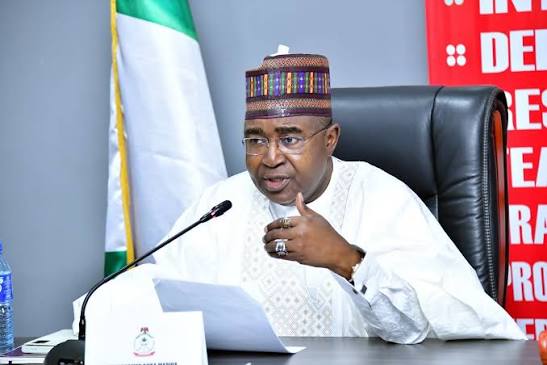
The Chairman of the National Drug Law Enforcement Agency (NDLEA), Brig. Gen. Buba Marwa (retd.) has called for a more effective financial offensive against drug cartels, saying the agency must go after the wealth and financial networks that sustain the illicit narcotics business.
“We should no longer assess the fight against drug trafficking mainly on the number of suspects arrested or quantities of drugs intercepted,” Marwa said, adding that criminal networks could recover quickly from such losses if their financiers and assets were left untouched.
He made the remarks in Abuja on Wednesday at the opening of a specialized training program for investigators and prosecutors on financial investigation, asset tracing and recovery.
The program is also focused on forfeiture and management of assets related to drug trafficking and other organized crimes.
According to the NDLEA chairman, “Drug trafficking should be treated as a business, which is all about the money, and the networks are beyond those arrested physically for transporting or selling narcotics.
Financiers, money launderers, facilitators and other professionals who help criminals disguise or transfer illicit funds are critical to the survival of drug organizations, he said.
He therefore charged investigators to pursue financial trails in addition to traditional drug investigations.
“If we arrest the courier without touching the financier, seize the drugs but allow the proceeds to remain with the criminal enterprise, or secure a conviction without recovering the illicit wealth, we have addressed only part of the problem,” said Marwa.
He said taking away traffickers’ financial power would make it more difficult for criminal organizations to replace the drugs seized, recruit new members and finance further operations.
“The drug networks were getting harder to track,” said Marwa, as criminals increasingly used technology and sophisticated financial arrangements to hide their proceeds.
Investigators now had to deal with cryptocurrency transactions, complex corporate structures and legitimate businesses that were allegedly used to disguise the source and ownership of criminal assets, he said.
The development, he told, called for a matching betterment of the technical proficiency of law enforcement officers.
NDLEA personnel, Marwa said, must be able to untangle complicated transactions, determine the real owners of assets, gather digital evidence and trace proceeds of crime beyond Nigeria’s borders.
“The sophistication of organized crime requires a sophistication in our response,” he said.
“We need to move from detecting crime to disrupting crime; from arresting offenders to dismantling criminal enterprises; and from confiscating drugs to depriving traffickers of the wealth that motivates and sustains their activities.”
NDLEA has made progress in intercepting narcotics and prosecuting suspects, but the next phase of the agency’s operations must focus on making the illicit drug business financially unattractive, Marwa said.
He said traffickers should not be allowed to retain properties, bank balances and other benefits they gained from criminal activities after their drugs had been confiscated.
The chairman of the NDLEA said that successful enforcement should deny criminal networks the resources to reestablish their operations.
He said the agency’s goal was to make narcotics trafficking a business in which the risks far outweigh the potential profits.
Marwa also pointed out the links between drug trafficking and other criminal activities, saying that drug networks often operate as part of a wider ecosystem of organized crime.
He said corruption, money laundering, cybercrime, human trafficking and illegal arms dealing were among the crimes that could overlap with the narcotics trade.
“The drug trafficking ecosystem is interlinked with money laundering, corruption, cybercrime, human trafficking, illicit arms trafficking and other forms of organized crime,” he said.
Such links necessitated cooperation between different law enforcement institutions, Marwa said.
He also called for closer coordination within the NDLEA especially between officers in charge of intelligence, investigations, prosecutions, forensic analysis and financial and asset investigations.
He said intelligence gathered by one department should feed into the work of others, and not be isolated.
The program was graced by officials of the Economic and Financial Crimes Commission (EFCC), Independent Corrupt Practices and Other Related Offenses Commission (ICPC) and the Nigeria Financial Intelligence Unit (NFIU).
Read Also: Two ISWAP Terrorists Surrender to Nigerian Army in Borno
The involvement of the institutions was important, Marwa said, as cooperation between investigators, prosecutors and the judiciary is often required for successful asset recovery.
Others who were engaged for the training included recently retired Circuit Judge Michael Hopmeier of the Southwark Crown Court in the United Kingdom; former ICPC Chairman Prof. Bolaji Owasanoye (SAN); and the Director of Public Prosecutions of the Federation, Rotimi Oyedepo (SAN).
Other participants were experts in cryptocurrency, money laundering and international asset recovery.
Besides identifying and confiscating criminal assets, Marwa warned officers of the dangers of mismanaging recovered property.
He said that if an asset was not properly managed, it could lose a lot of value between the time it was seized and the time it was disposed of.
He said mishandling of recovered assets could also raise doubts about the integrity of the forfeiture process.
He therefore demanded transparency at each stage, including seizure, forfeiture, custody, management and eventual realization of recovered assets.
Marwa urged officers attending the training to pass on the expertise they had gained to their colleagues and ensure that the lessons were seen in future investigations.
The agency expected participants to be better able to trace suspicious transactions, locate hidden assets, develop stronger evidence and obtain forfeiture orders against drug traffickers, he said.
The Chief Judge of the Federal High Court, Justice John Tsoho, also backed close cooperation between the judiciary and bodies fighting narcotics and financial crimes.
Justice Inyang Ekwo delivered a goodwill message on behalf of Tsoho, who said that the changing nature of drug-related offenses required more sophisticated law enforcement techniques.
The scope of narcotics crime had expanded beyond traditional drug trafficking to areas like financial crime and cryptocurrency-enabled money laundering, he said.
The message said the training subject showed “how extensive and multifaceted drug crimes are and can be, and their ever-expanding frontiers, which ought to be tackled by effective and sophisticated law enforcement.
Tsoho also commended the NDLEA leadership for its efforts in the fight against drug trafficking, saying that stronger cooperation between the Federal High Court and law enforcement institutions could enhance Nigeria’s image in the international fight against organized crime.
