

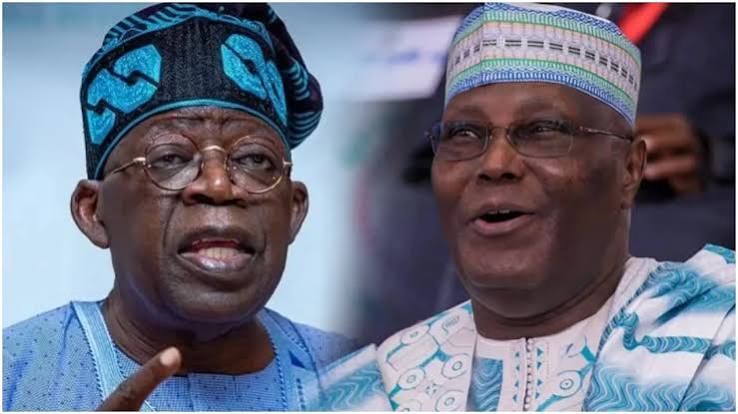
The Presidency has countered criticism of President Bola Ahmed Tinubu’s economic policies by former Vice-President Atiku Abubakar, stating that the reforms of the administration are beginning to yield positive results after initial challenges.
The Presidency also dismissed claims of fiscal recklessness, excessive borrowing and mismanagement of public finances, describing Atiku’s claims as misleading and based on outdated economic data.
The government’s stance was contained in a statement issued on Saturday, captioned, “Facts, Not Fear: A Point-by-Point Response to Atiku Abubakar on Nigeria’s Reform Journey,” by the Special Adviser to the President on Information and Strategy, Bayo Onanuga.
Onanuga accused the former vice-president of relying on economic indices of 2024 without taking into account the developments recorded since then.
“Politics is powered by disagreement. Democracy calls for it. But he said disagreements must be grounded in facts, not frozen images of history.”
“The public deserves context when yesterday’s data is presented as today’s reality.
He said economies are in constant evolution and reforms should be judged on the conditions at the end of their implementation and not on the conditions at the beginning.
“The first observation may be chronological. It is interesting that the opposition’s main economic argument in the middle of 2026 is still built on the developments of the 2024 fiscal year. Economies evolve. Reforms are processes, not events,” he said.
Read Also: Popular Juju, Highlife musician Saint Janet is dead
The presidential spokesman said the Tinubu administration’s foreign exchange reforms have led to improvement in Nigeria’s economy.
He said the country’s dollar-denominated Gross Domestic Product rose from about $253 billion after the exchange-rate adjustment to approximately $377 billion, while the naira value of the economy increased from about ₦314 trillion in 2024 to around ₦530 trillion.
In reaction to Atiku’s concern over the country’s debt burden, the Presidency argued that the sustainability of debt was more important than the total amount borrowed.
“There is a need to ask a wider question on Nigeria’s debt: What is Nigeria’s capacity to service her debt? “Debt per se is not the measure of fiscal health,” Onanuga said.
He said Nigeria’s debt-to-GDP ratio was still at around 40 per cent, which he described as relatively low compared to many African and developed economies.
The presidency also defended removal of fuel subsidy, saying the policy had drastically increased allocations to states and local governments.
Onanuga said that the extra revenue had allowed subnational governments to spend more on infrastructure, education, healthcare and other development projects.
“Subsidy removal has had the visible effect of significantly improving revenues accruing to states and local governments through the Federation Account,” he said.
The Presidency dismissed claims that the government had increased tax burdens on Nigerians on tax reforms.
“The essence of the tax reforms is not just about increasing collection, but about building a better and broader tax system,” Onanuga said.
He said the reforms were designed to ease the tax burden on low-income earners and small businesses, while increasing compliance among the wealthy and profitable companies.
The Presidency also challenged Atiku’s claim that the Federal Government benefited from an alleged ₦7.98 trillion oil windfall.
Onanuga said the calculation did not take into account the cost of production, the share of crude allocated to oil companies and existing crude sale agreements.
“There is no windfall of N7.98 trillion,” he said.
“The easy mistake that many analysts make is to multiply the oil price times the daily crude production volume to come up with revenue to the government.”
Favourable global oil prices have not translated into higher revenue for government due to crude-backed loan obligations and lower-than-expected production, he said.
The Presidency said the administration also made progress in healthcare, education and social intervention programmes, including the upgrade of over 3,000 primary healthcare centres, retraining of more than 78,000 frontline health workers and disbursement of over ₦303 billion through the Nigerian Education Loan Fund to more than 1.64 million students across 300 tertiary institutions.
Onanuga said the reforms were laying the groundwork for long-term economic stability, despite short-term hardships.
History doesn’t often remember governments for the popularity of their decisions in the moment. “It remembers if those decisions ultimately built up or tore down the nation,” he said.
He said the economy was yet to get to the destination it was heading to but the Tinubu administration would continue to implement reforms to expand opportunities, strengthen institutions and improve the living standards of Nigerians.
